Construction

Best Drainage for Retaining Walls: Protect Sloped Yards

Posted on:

Your backyard isn’t just sloping, it’s a funneling machine that’s actively trying to push many tons of wet soil right through your expensive masonry. This hydrostatic pressure buildup is the silent killer of hardscaping. It’s a structural nightmare. But it’s also solvable. Finding the best drainage solutions for retaining walls around sloped yards depends on how you capture and move that water before it hits the wall. You need a system that breathes. You need physics on your side.

How does hydrostatic pressure threaten your retaining wall?

Gravity never sleeps. It’s pulling every drop of rain down your slope and directly against the back of your wall. When soil stays saturated, it expands and becomes heavy. This weight creates hydrostatic pressure that can crack stone and shift heavy concrete blocks. Your wall needs to be a sieve, not a dam. Most failures happen because water had nowhere to go. It builds up. It pushes. Eventually, the wall bows or collapses entirely.

Proper drainage keeps the soil behind the wall stable. It prevents the ground from becoming a liquid slurry. Stone and timber can handle vertical weight easily. They struggle with lateral pressure. You must reduce that pressure to zero.

Dry walls stay upright. Wet walls fail. It’s as simple as that. You’re building a defense system against the elements. Each layer of your wall must work together to move water away.

What are the best drainage solutions for retaining walls around sloped yards?

Effective management requires a multi-layered approach to soil moisture. You cannot rely on a single pipe to do all the heavy lifting. The best drainage solutions for retaining walls around sloped yards involve combining surface collection with subsurface relief. This means using French drains as your primary line of defense. These perforated pipes sit at the base of your wall’s heel. They act like a vacuum for groundwater.

You also need granular backfill. This is typically clean, 1-inch crushed stone or angular gravel. Unlike dirt, gravel doesn’t hold onto water. It allows it to drop straight down to the drain pipe. This ensures the soil directly behind the wall stays relatively dry.

Surface swales are also critical. These are shallow, grass-lined channels that catch water coming down the slope. They redirect the flow before it ever reaches the retaining structure. Think of them as a moat for your wall. They intercept runoff and send it to a safer discharge point.
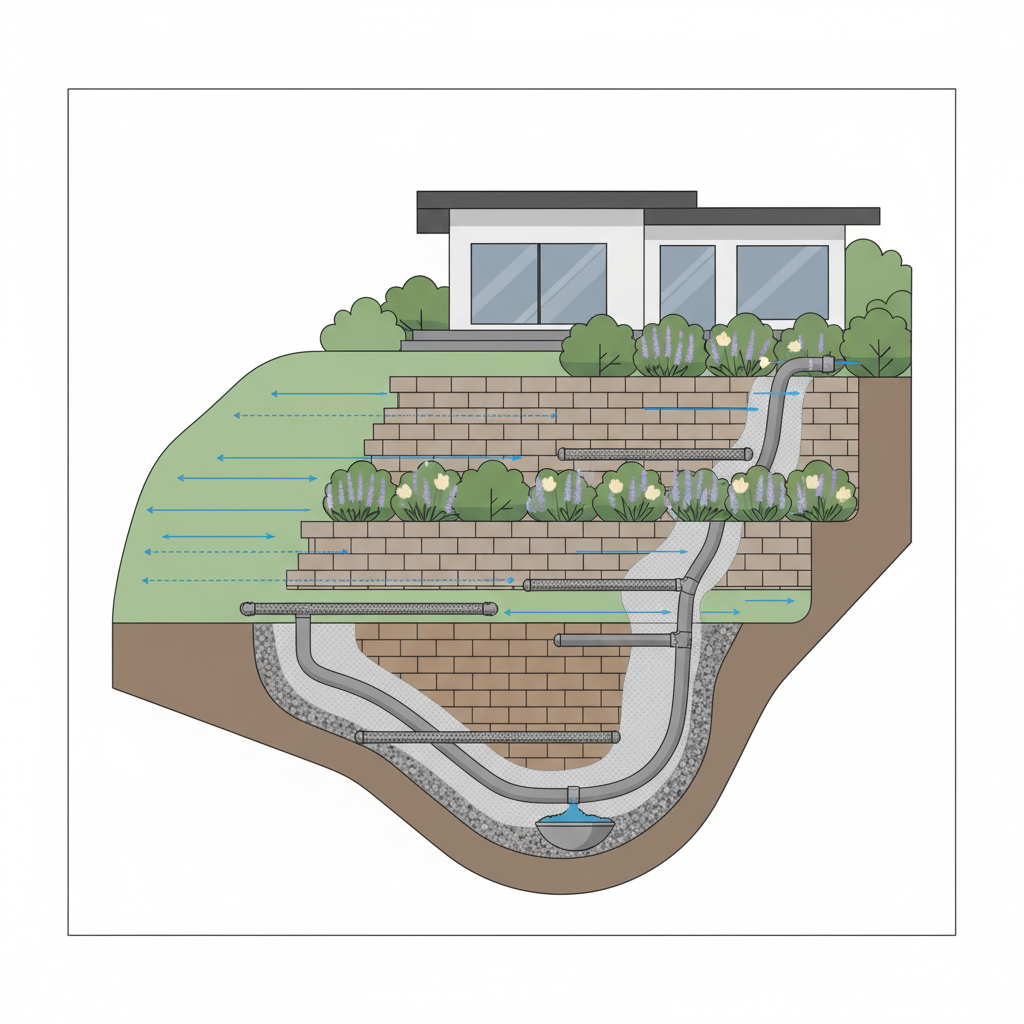
best drainage solutions visual example and applications

Why is gravel backfill essential for sloped yard drainage?

Dirt is the enemy. Standard garden soil or clay acts like a sponge and holds moisture for days. This creates a constant heavy load against the back of your structure. When you use gravel backfill, you create a high-flow highway. Water hits the gravel and falls instantly. It can’t build up pressure.

You should use at least 12 inches of gravel directly behind the wall. More is better for steep slopes. This gravel layer should extend from the base all the way to a few inches below the surface. Top it with a thin layer of soil and sod for aesthetics.

Never use pea gravel. Pea gravel is round and rolls like ball bearings. Use angular crushed stone instead. It locks together to provide structural support while keeping the drainage pits open. It’s the backbone of a long-lasting wall.

How do weep holes prevent water buildup in masonry walls?

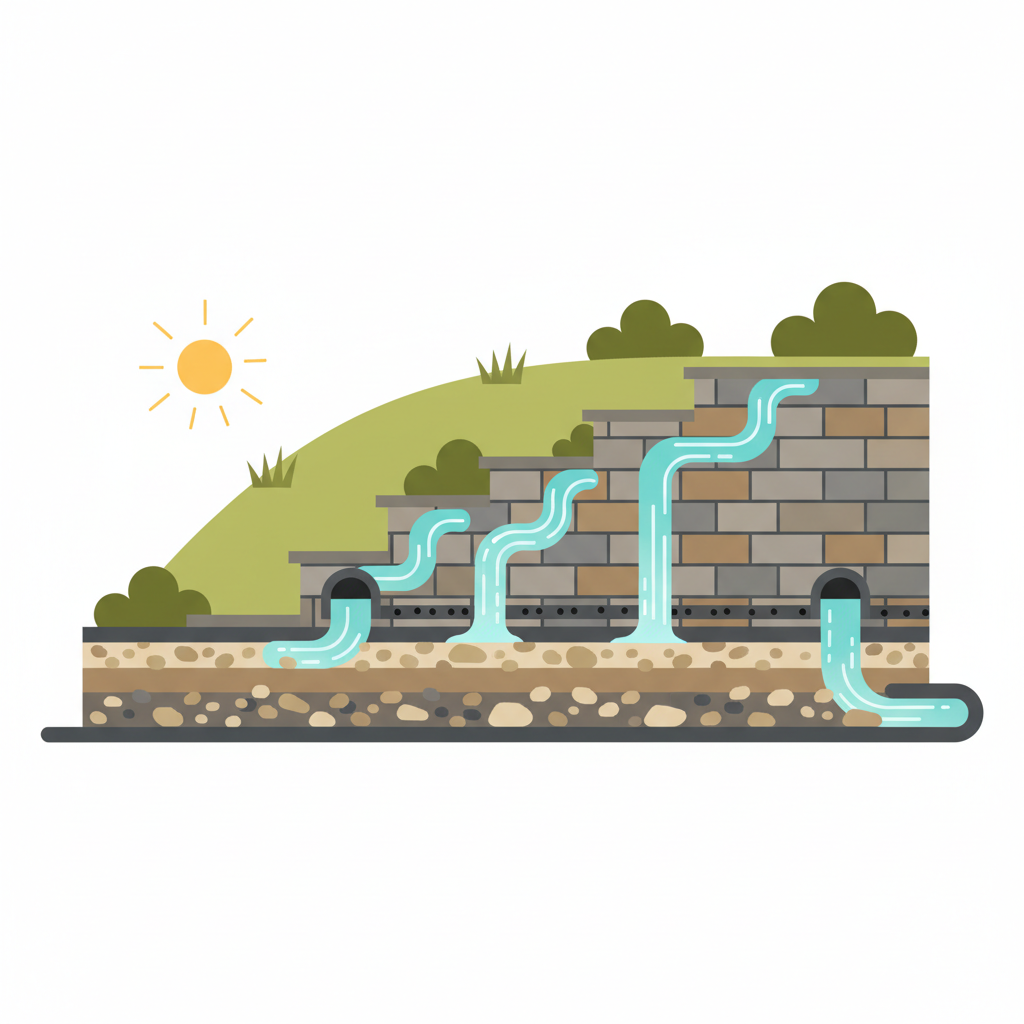
Water will find a way out. If you don’t give it an exit, it will make its own. Weep holes are small openings at the base of the wall that allow trapped water to escape. In stone or brick walls, these are often gaps in the mortar. In timber walls, they can be small drilled holes.

They work in tandem with the gravel backfill. As water drops through the gravel, it hits the bottom and flows out through these holes. This prevents the pudding effect at the base of your wall. Without them, water pools at the foundation.

This pooled water can undermine the footing. In cold climates, trapped water freezes and expands. This heave can lift the entire wall off its base. Weep holes are your pressure relief valves. Don’t skip them.

Can French drains handle heavy runoff on steep slopes?

Steep slopes move water fast. A standard French drain is a perforated pipe wrapped in filter fabric. On a slope, you need a high-capacity system. Use a 4-inch or 6-inch perforated NDS pipe. Ensure it is sloped at a minimum 1% grade toward the discharge area.

The filter fabric is non-negotiable. It prevents silt and fine soil from entering the pipe. If the pipe clogs, the entire system is useless. You would have to dig up the whole wall to fix it.

Position the pipe at the very bottom of the gravel trench. It should be slightly above the footing level. This ensures it catches every drop before it can seep under the wall. Direct the exit pipe to a dry well or a street-side storm drain.

Should you use swales or trench drains for surface water?

Surface water is a different beast. Trench drains, or channel drains, are grated systems that sit flush with the ground. They are perfect for the bottom of a steep hill right before the wall starts. They catch the massive volume of water that rushes over the grass during a storm.

Swales are a more natural-looking alternative. They are basically wide, shallow ditches. When properly graded, they look like a gentle dip in the landscape. You can plant them with water-loving grasses or line them with river rock.

Both methods reduce the amount of water the retaining wall has to process. It’s always easier to move water on the surface than underground. Combining a surface swale with a subsurface French drain is the gold standard. This is how you protect a high-value landscape.

What role does filter fabric play in retaining wall longevity?

Soil migration ruins systems. Over time, water carries tiny particles of dirt into your gravel. This creates a thick, muddy mess that blocks water flow. Geotextile filter fabric acts as a barrier between the native soil and your drainage gravel.

You should wrap the entire gravel column. It’s like a burrito of stone. The fabric allows water through but keeps the dirt out. This keeps your gravel clean and free-flowing for decades.

Cheap landscape fabric won’t work. Use non-woven geotextile fabric designed for drainage. It’s tougher and won’t tear during the backfilling process. It’s a small investment that doubles the life of your wall.

How do you manage downspout runoff near a retaining wall?

Roof water is a hidden threat. A single heavy rain sends hundreds of gallons of water off your roof. If your downspouts dump this water near the top of a sloped yard, your retaining wall is in trouble. It’s like a fire hose pointed at your foundation.

Never let downspouts drain onto the slope above a wall. You must pipe that water directly away. Use solid PVC pipes for this, not perforated ones. You want to move that water to the bottom of the hill without it ever touching the soil behind the wall.

Connect all downspouts to a dedicated drainage line. Bury it at least 12 inches deep. Discharge it far away from any structures or walls. This simple step removes about 50% of the water stress from your landscape.

What are the best materials for walls in high-moisture areas?

Material choice matters. Wood and timber look great but they eventually rot. Even pressure-treated wood struggles if it’s constantly wet. If you have a very wet slope, steer toward pre-cast concrete blocks or poured concrete.

Poured concrete is incredibly strong. It is less likely to allow water to seep through the face. However, it still requires heavy drainage behind it to prevent tipping. Pre-cast blocks with interlocking lips are excellent for sloped yards. They are designed to lean back into the hill slightly.

Natural stone is beautiful but porous. If you use it, you must be even more diligent with your gravel backfill. Each material has its pros and cons. But all of them will fail without a plan to move the water.

How do you design a discharge point for your drainage system?

Captured water has to go somewhere. If you just end your pipe at the edge of the wall, you’re creating a new problem. The discharge point should be a low area of the property where water won’t cause erosion.

Using a pop-up emitter is a smart choice. It stays flush with the grass until the pipe fills. Then, the lid pops up and lets the water flow out over the lawn. This prevents rodents from nesting in your pipes during the summer.

On very steep slopes, use a rip-rap apron. This is a small area of heavy rocks at the pipe exit. It breaks the speed of the water. This prevents the water from carving an ugly hole in your yard.

Protect your landscape with professional drainage design

Building a wall without a plan for water is just a slow-motion disaster. You need to think about the path of every drop. Start by identifying the best drainage solutions for retaining walls around sloped yards that fit your specific soil type. If you have heavy clay, you need more gravel. If you have a steep hill, you need bigger pipes.

Don’t cut corners on the things you can’t see. The fabric, the pipe, and the stone are the parts that actually do the work. The pretty blocks on the front are just the face of the operation. Spend your money on the guts of the system.

If you aren’t sure about your grading, call a pro. A slight mistake in the slope of a pipe can lead to a massive failure. Do it right the first time. Your yard will be dry, and your wall will stay standing for years to come.

Frequently Asked Questions About Retaining Wall Drainage

Can I use a retaining wall without a drain pipe?
Only if the wall is very short. Anything over two feet tall should have a pipe. Even short walls live longer with proper drainage. Without a pipe, you’re relying entirely on the soil’s ability to absorb water. That’s a big risk during a heavy storm.

What is the best type of pipe for wall drainage?
Schedule 40 PVC with perforations is the top choice. It’s strong and doesn’t crush easily under the weight of the gravel and soil. Corrugated black pipe is cheaper but it can clog more easily. Corrugated pipe also tends to hold onto silt because of its internal ridges.

How much gravel do I really need behind the wall?
Aim for a minimum of 12 inches. If your slope is particularly steep or the soil is heavy clay, increase that to 18 or 24 inches. This gravel column should run from the footing all the way up to just below the surface. Volume matters when it comes to managing high-speed runoff.

Do I need to clean out my retaining wall pipes?
If you used filter fabric, you shouldn’t have much maintenance. However, it’s a good idea to check the exit points once a year. Make sure no grass or debris is blocking the flow. If the water stops coming out during rain, you might have a clog that needs flushing.


Business / Construction / Home

Post Top Lights for Commercial and Residential Areas

Posted on:

Choosing Post Top Lights is like selecting the perfect pair of glasses for a building. You can follow the blueprints perfectly. The structure still might look unfinished. And you won’t know how much character is missing until the right fixture illuminates the facade. In 2026, lighting is no longer a mere utility but a strategic asset for safety and property value. It’s the difference between a dark, uninviting path and a welcoming entrance that guides you home. Whether you’re managing a sprawling retail center or a quiet suburban driveway, these fixtures provide the essential glow that defines your space after the sun sets.

Modern lighting technology has moved far beyond simple bulbs on sticks. Post Top Lights now integrate smart sensors, high-efficiency LEDs, and architectural designs that complement any environment. They create a sense of place. They offer security. They make people feel safe. But most importantly, they transform how we interact with the outdoors at night. From solar powered lamp post light with pier mount options to heavy-duty commercial led post top area lighting, the choices you make today will impact your property’s energy bills and aesthetic appeal for the next decade.

Why Are Post Top Lights Important for Modern Landscapes?

Lighting defines boundaries. It tells the eye where a property begins and where the public sidewalk ends. Pole mounted outdoor fixtures serve as silent sentinels that provide both beauty and protection. When you install high-quality luminaires, you aren’t just buying a lamp. You’re investing in a visual hierarchy. This hierarchy helps visitors navigate complex layouts with ease. It’s about clarity. It’s about confidence.

Security is the silent driver of most lighting decisions in 2026. Criminals prefer shadows. Well-placed Post Top Lights eliminate those hiding spots while adding a layer of sophistication to the landscape. A brightly lit perimeter sends a message of care and vigilance. It’s a deterrent. It’s a comfort. Property managers often find that upgrading to architectural outdoor lighting reduces liability and increases the perceived value of the entire site. People gravitate toward light because it represents safety and community.

Enhancing Safety with Pedestrian Scale Luminaires

Scale matters immensely. Pedestrian scale luminaires are designed to sit at heights that feel comfortable for humans on foot. They don’t tower over you like massive highway poles. Instead, they provide a gentle, downward light that illuminates faces and paths. This human-centric approach reduces the glare that often blinds walkers in poorly lit areas. It makes the night navigable. It encourages walking.

Public spaces thrive when people feel comfortable lingering after dark. In parks and town squares, the right light levels prevent trips and falls. They allow for facial recognition at a distance, which is a key factor in psychological comfort. And because these fixtures are at eye level, their design must be flawless. They are part of the scenery. They are functional art.

Creating Curb Appeal with Architectural Outdoor Lighting

First impressions happen in the dark. Architectural outdoor lighting acts as the finishing touch that ties a landscape design together. For a luxury home, a set of black traditional outdoor post lanterns can evoke a sense of timeless elegance. For a modern office park, sleek and minimalist fixtures signal innovation and forward-thinking. The finish of the fixture is just as important as the light it emits. It must resist corrosion. It must look premium.

Retail centers use these lights to draw customers in from the street. A well-lit parking lot and walkway suggest a premium shopping experience. It’s a branding tool. It’s a silent salesman. When the hardware matches the architectural style of the buildings, the entire property feels cohesive and intentional. You’re not just lighting a path. You’re telling a story about the quality of the destination.

What Are the Best Commercial LED Post Top Area Lighting Options?

Commercial spaces demand durability. Commercial led post top area lighting must withstand extreme weather while delivering consistent performance every single night. In 2026, the focus has shifted toward high-lumen density and precision optics. These aren’t your standard residential lamps. They are engineered to cover vast stretches of asphalt and concrete with uniform brightness. They are tough. They are efficient.

Business parks and university campuses require a specific balance of light. You need enough brightness to ensure safety but not so much that you create light pollution for neighboring areas. Modern commercial outdoor led pole lights for parking lots use advanced shielding to direct light exactly where it’s needed. This precision saves money. It protects the night sky. It keeps everyone happy.

Optimizing Safety with Commercial Outdoor LED Pole Lights for Parking Lots

Parking lots are high-risk zones. Commercial outdoor led pole lights for parking lots must provide enough vertical and horizontal illumination to make every corner visible. High-lumen output is the priority here. You want a wide beam spread that minimizes the number of poles required to light the area. This reduces installation costs. It cleans up the landscape. It works better.

Uniformity is the secret to a safe parking area. If you have “hot spots” of bright light followed by deep shadows, the human eye struggles to adjust. This creates a hazard for drivers and pedestrians alike. By using high-performance Post Top Lights, you ensure that the entire surface is covered in a steady wash of light. It’s safer. It’s professional. It’s the standard for 2026.

Decorative Post Top Fixtures for Business Parks and Campuses

Function doesn’t have to be ugly. Decorative post top fixtures for business parks allow organizations to maintain a professional image while meeting technical lighting requirements. These fixtures often feature customizable colors and logos to match corporate branding. They are more than lights. They are landmarks. They help with wayfinding.

On a college campus, these lights create a sense of tradition and security. Students walking to late-night study sessions rely on the glow of these fixtures to find their way across the quad. Designers often choose acorn style post top lights for these settings because they bridge the gap between historic charm and modern LED efficiency. They look old-fashioned. They perform like the future. They last for years.

Post Top Lights visual example and applications

How Do Solar Powered Lamp Post Lights with Pier Mounts Perform?

Solar tech has finally caught up to our expectations. A solar powered lamp post light with pier mount is now a viable primary lighting source for many properties. No longer are these just dim accent lights that fade after three hours. In 2026, high-efficiency panels and massive battery storage allow these units to shine brightly all night long. They are independent. They are green.

The beauty of solar is the lack of wires. You don’t have to trench your yard or hire an expensive electrician to run conduit under your driveway. You simply bolt the fixture down and let the sun do the work. It’s a fast upgrade. It’s a smart one. For many homeowners and small businesses, this is the most cost-effective way to add exterior column lighting without a major construction project.

Benefits of Integrated Solar Technology

The secret is in the cells. 2026 models of Post Top Lights use mono-crystalline solar panels that can harvest energy even on cloudy days. These panels are paired with lithium iron phosphate batteries which offer thousands of charge cycles without losing capacity. They are reliable. They are durable. You can trust them to work in the winter.

Integrated sensors also play a huge role in performance. Most solar units now feature dusk to dawn outdoor post lights capability as a standard feature. They turn on automatically when the sun sets and dim themselves slightly after midnight to conserve power. This intelligent management ensures you have light when you need it most. It’s set-and-forget technology. It’s brilliant.

Installing Exterior Column Lighting and Pier Mounts

Versatility is the main selling point for pier mounts. Exterior column lighting allows you to place a light on top of a brick pillar, a stone wall, or a flat concrete pad. The pier mount base acts as an adapter that secures the fixture to the surface. It’s sturdy. It’s permanent. It looks like it was built into the architecture.

When installing these on a column, height is your friend. Placing a solar powered lamp post light with pier mount at the entrance of a driveway creates a majestic focal point. It frames the entry. It provides a warm welcome. Because there are no wires, you can even install these on remote gate posts far away from the main house. It’s freedom. It’s convenience.

Which Decorative LED Post Tops for Cityscapes Provide the Best Value?

Cities are the ultimate testing ground for lighting. Decorative led post tops for cityscapes must be vandal-resistant, energy-efficient, and aesthetically pleasing to a diverse population. Urban planners look for fixtures that can survive the rigors of city life while enhancing the local culture. They want value. They want longevity. They want style.

Value in 2026 is measured by more than just the purchase price. It’s about the total cost of ownership over twenty years. Cities are moving toward energy efficient walkway post lighting that requires almost zero maintenance. When a fixture can run for 100,000 hours without a bulb change, the savings in labor are enormous. It’s a smart investment. It’s a long-term win.

The Timeless Appeal of Acorn Style Post Top Lights

Some designs never go out of style. Acorn style post top lights are a staple of American “Main Street” architecture for a reason. They provide a nostalgic feel that makes a downtown area feel cozy and historic. But don’t let the old-school look fool you. Inside that glass or acrylic globe sits a high-tech LED engine. It’s powerful. It’s efficient.

Modern versions of these lights use refractive globes to spread light evenly without creating glare. This is crucial for drivers who need to see pedestrians clearly in busy urban corridors. You get the charm of the 1920s with the performance of 2026. It’s the best of both worlds. It’s a classic choice that residents always love.

Smart Controls for Municipal Energy Savings

The “Smart City” is powered by light. Many Post Top Lights installed in urban areas now feature wireless nodes that talk to a central hub. This allows city managers to dim lights during low-traffic hours to save electricity. It’s data-driven. It’s responsive. If a light fails, the system automatically sends an alert to the maintenance crew.

Telemetry in these fixtures can also track traffic patterns or air quality. The light pole becomes a piece of digital infrastructure. By integrating these sensors, cities can justify the cost of the upgrade through massive energy savings and improved services. It’s not just a lamp. It’s a node in a giant network. It’s the future of municipal management.

Why Choose Dusk to Dawn Outdoor Post Lights for Your Home?

Convenience is a luxury you can afford. Dusk to dawn outdoor post lights take the guesswork out of home security. You never have to remember to flip a switch. You never have to come home to a dark house. The built-in photocell detects the light levels and acts accordingly. It’s simple. It’s effective.

This automation is also a safety feature. A house that is always lit at night looks occupied, which can deter potential intruders. It provides a consistent look for your neighborhood. And because modern LEDs use so little power, leaving them on all night costs only pennies a month. It’s peace of mind. It’s affordable.

Selecting Black Traditional Outdoor Post Lanterns

You can’t go wrong with a classic. Black traditional outdoor post lanterns are the most popular choice for residential properties in 2026. The matte black finish is incredibly versatile. It looks great against red brick, white siding, or natural stone. It’s bold. It’s clean.

When choosing a style, consider the “bones” of your home. A Colonial-style house looks best with a formal, four-sided lantern. A Modern Farmhouse might call for something with cleaner lines and an oversized Edison-style LED bulb. The goal is to complement the architecture, not compete with it. A well-chosen Post Top Light acts as a piece of jewelry for your front yard. It adds that final “pop” of style.

Finding the Right Lamp Post Replacement Heads

Don’t tear down that old pole just yet. If your existing post is still sturdy, you can simply swap out the top. Lamp post replacement heads are designed to fit standard three-inch diameter poles. It’s an easy DIY project. It’s a huge upgrade for a small price. You can transform the look of your yard in thirty minutes.

When shopping for a replacement, check the mounting hardware. Most modern Post Top Lights come with a standard collar that slips over the pole and secures with set screws. Make sure the new head is proportional to the height of your pole. A head that is too small will look lost, while one that is too large will look top-heavy. Balance is key. Proportions matter.

How to Plan Energy Efficient Walkway Post Lighting?

Planning is everything. Energy efficient walkway post lighting requires more than just picking a pretty fixture. You have to think about the path of travel. You have to think about the shadows. A poorly planned layout can actually make a walkway more dangerous by creating “blinding” spots and “black holes.” It takes thought. It takes a plan.

Start by identifying the key transition points. You need light at stairs, turns, and entryways. Once those are covered, you can fill in the gaps along the straightaways. The goal is a seamless transition of light from one fixture to the next. It’s a flow. It’s a guide.

Calculating Spacing for Uniform Illumination

Avoid the “runway” look. You don’t need a light every two feet. For most Post Top Lights, a spacing of 10 to 15 feet is ideal for residential walkways. In commercial settings, you might go further apart if the fixtures are taller and more powerful. It’s about foot-candles. It’s about coverage.

A foot-candle is a measurement of light intensity on a surface. For a safe walkway, you generally want at least 0.5 to 1.0 foot-candles of light. You can test this with a simple light meter app on your phone. If you see a dark spot where the light from two poles doesn’t meet, you need to adjust your spacing. Consistency is the hallmark of a professional installation. It looks better. It feels safer.

Color Temperature Considerations for Outdoor Ambience

Color changes everything. The temperature of your light is measured in Kelvins (K). For residential areas, 3000K is the “sweet spot.” It provides a warm, inviting glow that looks natural against landscaping and skin tones. It’s cozy. It’s classic.

In contrast, commercial led post top area lighting often uses 4000K or 5000K. This “cool” light is much crisper and helps with visibility in parking lots and high-security areas. It makes colors look more vivid and improves the clarity of security camera footage. However, you should avoid using these high temperatures near bedroom windows or in quiet neighborhoods. It can feel harsh. It can disrupt sleep. Choose the temperature that fits the vibe of the space. Match the mood.

Ready to Upgrade Your Property With Advanced Post Top Lighting?

The right Post Top Lights do more than just fight the darkness. They define your property’s identity. They protect your family and your customers. They increase your home’s value while reducing your energy footprint. In 2026, the technology is more accessible and powerful than ever before. You have the options. You have the power.

Don’t settle for mediocre illumination. Whether you need commercial outdoor led pole lights for parking lots or a single black traditional outdoor post lantern for your driveway, quality matters. Look for fixtures with long warranties and high-efficiency ratings. Consider the long-term savings of LED and solar. Think about the safety of everyone who visits your property.

Now is the time to take action. Take a walk around your property tonight. Look for the dark corners. Identify the spots where a beautiful new fixture could make a difference. Consult with a lighting expert to create a custom plan that fits your budget and your style. Browse the latest 2026 catalogs to find the perfect match for your vision. Your property deserves to shine. Make it happen.

Construction

Modern Privacy Fence vs Stone Wall: Best Choice for New H…

Posted on:

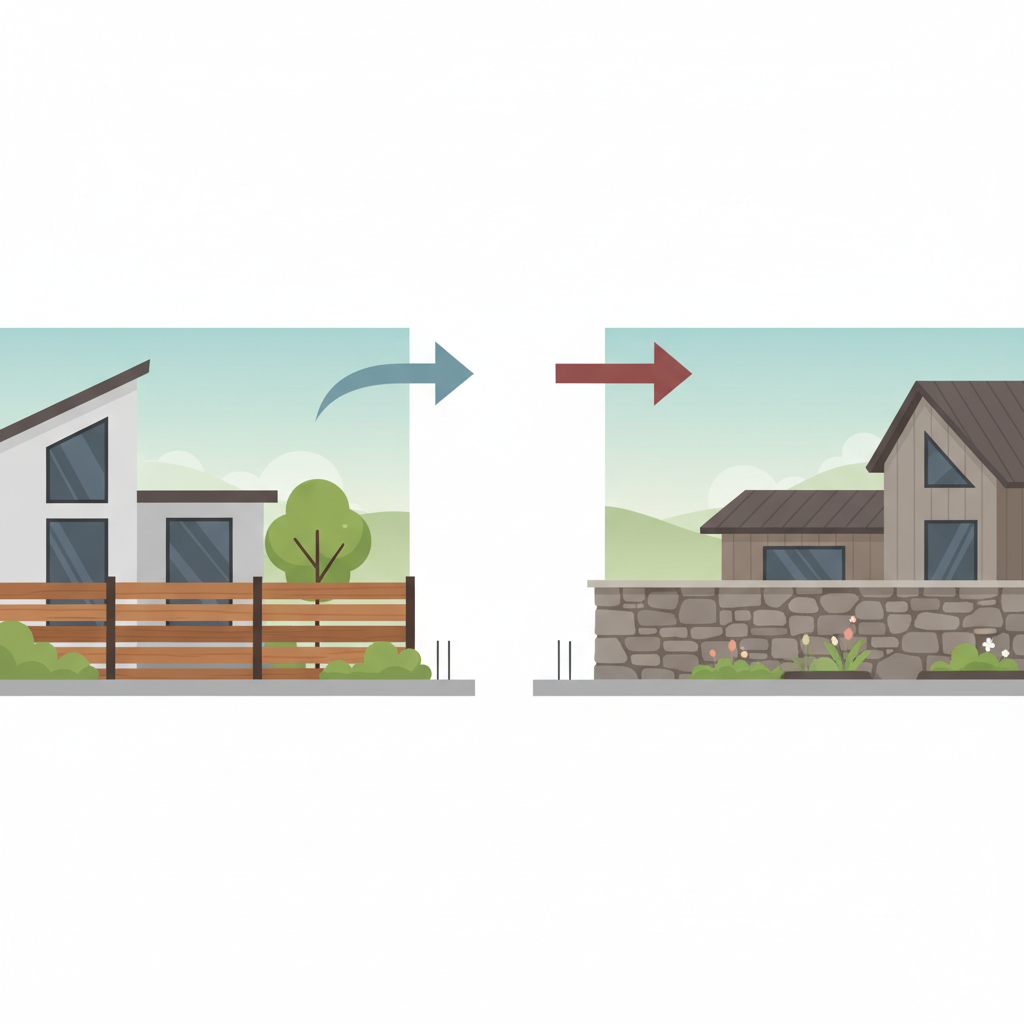
Stone walls always increase property value. You’ve heard this from every real estate agent and contractor for decades. It’s not necessarily true in the current housing market where speed and design flexibility often dictate a project’s success. Choosing between a modern privacy fence vs stone wall for new construction homes requires you to look beyond simple durability. You need to consider how your choice impacts your timeline, your budget, and the specific architectural style of your new build. It’s a decision that defines your home’s perimeter for generations.

The choice is heavy. It impacts your curb appeal instantly and forever. When you’re standing on a fresh plot of dirt, the boundary you choose sets the tone for everything inside. You want security. But you also want a look that doesn’t feel dated by the time you move in. Today’s homeowners are leaning toward sleeker lines and faster installs. But the timeless weight of masonry still calls to those looking for a permanent legacy. Let’s look at how these two heavyweights stack up in 2026.

Which option offers the best return on investment for new builds?

Money matters most. You’re already deep into construction costs, and every line item on your budget is under a microscope. A modern privacy fence vs stone wall for new construction homes presents a massive gap in initial capital requirements. Stone is labor intensive. It requires skilled masons who charge a premium for their time and expertise. You’re paying for raw materials, footings, and weeks of meticulous stacking. It’s a slow burn for your wallet. But it holds value well.

Fencing is different. It’s fast. Modern materials like composite, horizontal cedar, or powder-coated aluminum offer a high-end look at a fraction of the cost of masonry. You can fence an entire acre in the time it takes to lay the foundation for a single stone pillar. And this speed translates directly into lower labor costs. But you don’t get the same centuries-long lifespan. You trade permanence for immediate style and cash flow. Don’t ignore the maintenance math either.

Stone walls are essentially set and forget. They don’t rot. Termites won’t eat them. They don’t need staining every three years. A high-quality fence will eventually need some love. Even the best composites can fade or require a power wash. If you plan to sell in five years, the fence wins on ROI. If you’re building a family estate for fifty years, the stone wall starts to look like the smarter financial play. It’s all about your personal timeline in this house.

How does a modern privacy fence compare in terms of installation speed?

Time is fleeting. When you’re building a new home, delays are your biggest enemy. A modern privacy fence vs stone wall for new construction homes comparison isn’t even close when it comes to the clock. Most modern fence systems are modular. They arrive on-site ready to be dropped into post holes. You can have a completed, private backyard in forty-eight hours. This allows other trades like landscapers and pool builders to start their work sooner. It streamlines the whole project.

Walls are slow. They’re heavy. You have to wait for the ground to settle or pour massive concrete footings to prevent shifting. If it rains, the masonry work stops. If the stones don’t match the first batch, you’re stuck waiting for a new shipment. A stone project can easily stretch into weeks or months. This can block access for heavy machinery needed elsewhere on your lot. It’s a logistical hurdle that many new homeowners aren’t prepared to clear. Speed has a value of its own.

And you must think about the mess. Mixing mortar and cutting stone creates significant site debris. It’s a dusty, loud process that can irritate your new neighbors before you’ve even moved in. Fencing is a much cleaner installation. There’s less waste. There’s less noise. If you’re under pressure from a homeowner’s association to finish your exterior work, the fence is your safest bet. It gets the job done without the drama of a long-term construction zone. You get your privacy now, not next season.

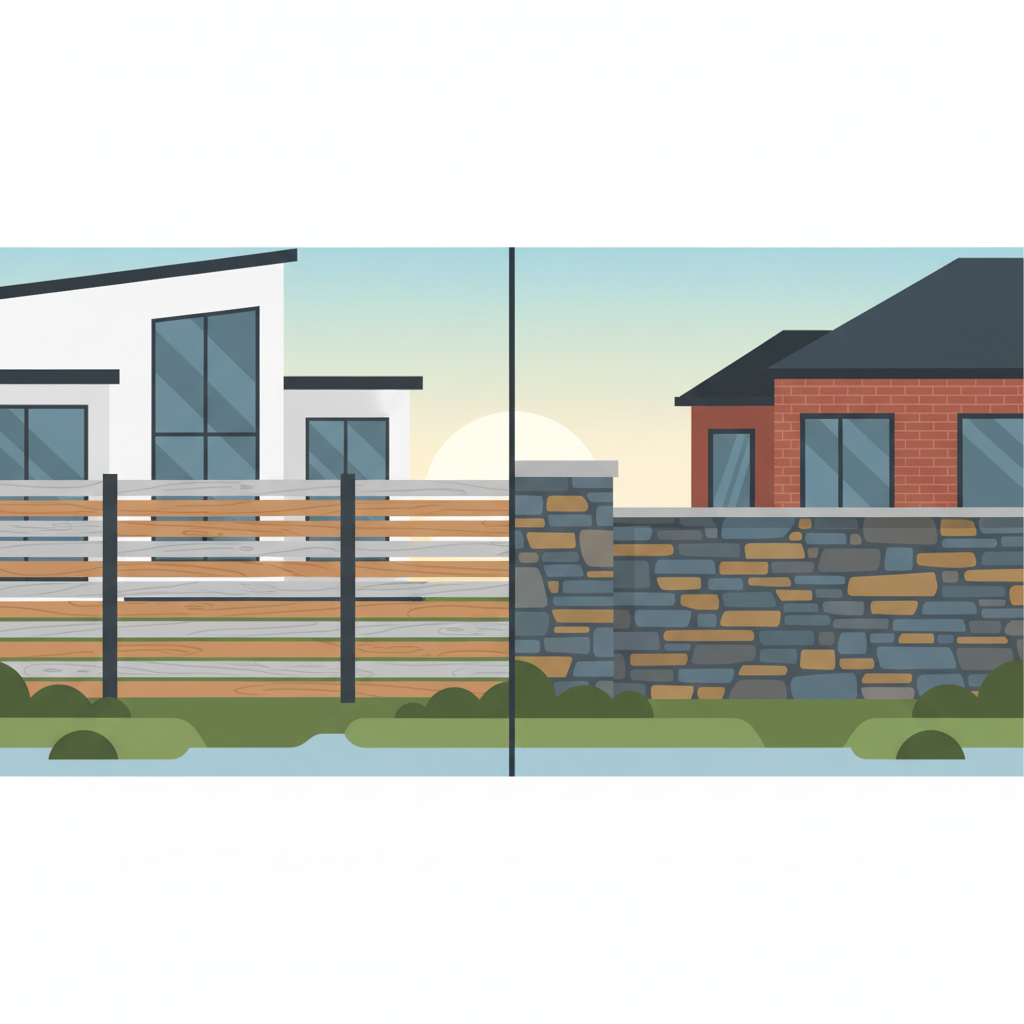
modern privacy fence visual example and applications

What are the aesthetic differences for contemporary home designs?

Design dictates mood. A modern privacy fence vs stone wall for new construction homes will completely change the vibe of your exterior space. Modern fences often feature horizontal slats that make a yard feel wider. They use mixed materials like metal and wood. This creates a textured, layered look that matches 2026 architectural trends. It feels light. It feels intentional. It’s the perfect backdrop for a minimalist garden or a sleek outdoor kitchen.

Stone is heavier. It’s grounded. A stone wall gives a sense of history and permanence that wood or metal can’t replicate. It works beautifully with organic modern designs or traditional estates. But stone can also feel cold. It’s a hard surface that reflects sound rather than absorbing it. If you have a small lot, a thick stone wall can make the space feel cramped or fortress-like. You have to balance that literal weight with soft landscaping. It takes more work to get right.

Think about height too. Most municipalities have strict rules about how high a solid wall can be. Fencing often gets more leeway. You can use lattice tops or semi-transparent slats to gain height without breaking code. This lets you block a neighbor’s second-story window while still letting light through. A stone wall is an all-or-nothing barrier. It doesn’t breathe. It’s a solid block of privacy that can sometimes feel like a prison wall if not designed with care. Choose the material that fits your vision.

Which boundary type offers better long-term durability and maintenance?

Stone is king. There’s no getting around the fact that a well-built stone wall will outlast any fence. We see stone structures from hundreds of years ago still standing today. It withstands extreme weather, from blistering heat to deep freezes. It doesn’t warp. It doesn’t lean. If you want a boundary that your grandchildren will see, stone is the only real choice. It’s the definition of a permanent structure. It’s built for the long haul.

Fences have improved. Modern composites are incredible. They use recycled plastics and wood fibers to create something that won’t rot or attract bugs. High-grade aluminum fences have coatings that resist salt and UV damage for decades. But they still have moving parts. Gates will eventually sag. Screws can loosen over time. Even the best modern privacy fence vs stone wall for new construction homes comparison shows that the fence is the more fragile option. It will need a check-up eventually.

But maintenance isn’t just about survival. It’s about look. A stone wall can grow moss or accumulate lime staining over time. Cleaning it requires specialized chemicals or light pressure washing. A fence might just need a quick wipe-down. If a tree limb falls on a fence, you replace a panel. If a tree limb hits a stone wall, you’re calling a mason for an expensive repair. You have to decide which type of work you’re willing to do. Both require an eye on the future.

How do local zoning laws impact your choice of material?

Rules rule. Before you buy a single bag of cement or a wooden post, you must check your local codes. Many new construction developments have restrictive covenants. They might ban stone walls entirely because of drainage concerns. Or they might mandate a specific type of modern privacy fence to keep the neighborhood looking uniform. You don’t want to build a masterpiece only to be forced to tear it down. It happens more often than you think.

Walls are heavy. They’re structures. In many jurisdictions, a wall over three or four feet requires an engineered drawing and a separate building permit. This adds cost and time to your project. Fences are usually treated as temporary or light structures. Permits are often easier to get. They’re faster to approve. If your property has a steep slope, a stone wall becomes a retaining wall. That’s a whole different level of engineering and expense. It complicates everything quickly.

And then there’s the property line. Fences are thin. You can put them right on the edge of your lot. Stone walls are thick. They might be twelve to eighteen inches wide. If you build it on the line, you might be giving up six inches of your yard to the other side. Or you might have to set it back, creating a weird no man’s land between your wall and the neighbor. It’s a spatial puzzle. Measure twice before you commit to the weight of stone.

Can you combine stone and modern fencing for a custom look?

Hybrid is best. You don’t have to choose just one when looking at a modern privacy fence vs stone wall for new construction homes. Some of the best-looking properties in 2026 use both. You can build a low stone base or knee wall and top it with modern horizontal fencing. This gives you the visual weight and durability of stone at the ground level where moisture is high. But it keeps the upper half light and airy. It’s the best of both worlds.

Stone pillars are another great option. You can space them out every eight or ten feet. Between the pillars, you install high-quality fence panels. This creates a rhythmic, high-end look that feels more expensive than it is. It anchors the fence to the ground. It makes the whole perimeter look like it was designed by an architect. It’s a strategic move for curb appeal. It creates a sense of luxury without the total cost of a solid stone barrier.

And let’s talk about landscaping. You can use stone for the front of the house to impress guests and neighbors. Then switch to a modern privacy fence for the backyard where you just need a place for the kids to play. Nobody says the whole lot has to be identical. Use the stone where it adds the most value. Use the fence where it adds the most function. It’s a smart way to manage your budget while still getting a premium look. Mix and match with confidence.

What are the environmental impacts of each material?

Green is the goal. Your choice of modern privacy fence vs stone wall for new construction homes has a carbon footprint. Stone is natural, but quarrying and transporting it is energy-intensive. It’s heavy to move. It takes a lot of fuel to get it to your site. However, it’s a one-time cost. Once it’s there, it stays for centuries. It doesn’t release chemicals into the soil. It’s as inert as it gets. It’s the ultimate sustainable choice if you think in terms of centuries.

Fences are getting greener. Recycled composites keep plastic out of landfills. Many wood fences now come from FSC-certified forests. But manufacturing these products involves factory processes. They have a shorter lifespan. When a fence reachers the end of its life, it might end up in a landfill. Some metals are highly recyclable, which is a plus. But you have to look at the whole lifecycle. A fence you replace three times in fifty years has a different impact than one stone wall.

Think about your local ecology. A solid stone wall can block the movement of small animals like turtles or hedgehogs. It’s a hard barrier for nature. A fence, especially one with a small gap at the bottom or between slats, is more permeable. It lets the wind through. It lets small critters through. It doesn’t change the micro-climate of your yard as much as a heat-absorbing stone wall might. Sustainability is about more than just the material. It’s about how the structure lives with the land.

Choose the boundary that fits your 2026 lifestyle

Your home is your sanctuary. The decision between a modern privacy fence vs stone wall for new construction homes shouldn’t feel like a chore. It’s an opportunity to define your space. Start by looking at your immediate needs. Do you need privacy by next week? Go with a modern privacy fence. Are you building your forever home and want a legacy? Build the stone wall. Don’t let trends dictate a choice that you’ll have to live with for years. Trust your gut and your budget.

Check your site conditions. If you have sandy soil or a lot of shifting, a heavy wall might be a mistake. If you live in a high-wind area, a sail-like fence could be a liability. Talk to a local contractor who knows the area’s geology. They can tell you what works and what fails. And don’t forget to look at your house. Your boundary should feel like an extension of your architecture. It should lead the eye toward your front door, not distract from it. Make it count.

You have the power to create a peaceful, private environment. Whether you choose the sharp, clean lines of a horizontal slat fence or the rugged, timeless texture of natural fieldstone, make sure it serves you. A home is more than just four walls. It’s the whole lot. Your perimeter is the first thing you see when you arrive and the last thing you see when you leave. Choose something that makes you proud to be home. Take the leap and secure your view.

Ready to start? Get three quotes from different specialists to see the real-world cost in your zip code. Compare those numbers against your move-in date and your long-term goals. Your dream home deserves a boundary that’s just as beautiful as the interior. Get out there and build it.

Frequently Asked Questions

  • Which is more expensive, a modern fence or a stone wall?
    In almost every case, a stone wall is significantly more expensive. This is due to the high cost of raw materials and the specialized labor required for masonry. A modern fence can offer a similar level of privacy for 30% to 50% of the price of a wall.
  • How long does a stone wall typically last?
    A well-constructed stone wall with proper footings can last over 100 years. Unlike wood or even some composites, stone does not rot or suffer from insect damage. It is the most durable boundary option available for residential properties.
  • Do I need a permit for a modern privacy fence?
    Yes, most cities require a permit for any fence over a certain height, usually six feet. Stone walls often have even stricter requirements. They may require an engineering plan if they are over three feet tall or acting as a retaining wall. Always check with your local building department first.
  • Can a modern fence increase my home’s value as much as stone?
    A high-quality modern privacy fence can significantly boost curb appeal and attract buyers who want immediate privacy. While stone is often seen as more prestigious, a stylish, well-maintained fence is a major selling point in contemporary real estate markets.
Construction

Sloped Land Building: 5 Hidden Costs to Watch For

Posted on:

Your dream home sits on a hillside. The view looks breathtaking, but your bank account is about to take a massive hit. Many homeowners ignore the hidden costs of building a house on sloped land until the first excavation bill arrives. You might think you’ve found a bargain on a steep lot. The price tag is low for a reason. Realizing the financial reality of grade changes now will save you from a mid project disaster. Most builders won’t mention the true price of dirt until it’s too late for your budget.

Why is excavation more expensive on a hill?

Dirt gets pricey fast. Removing tons of earth requires heavy machinery and specialized operators who charge by the hour. When you calculate the hidden costs of building a house on sloped land, start with the cut and fill process. You’re either digging out a giant hole or trucking in massive amounts of structural soil. This isn’t a simple afternoon job for a tractor. It’s a weeks long battle against gravity and geology. You’ll pay for every cubic yard moved.

Bedrock is the enemy. You might hit solid stone just three feet down. Blasting through rock requires dynamic permits and expensive equipment that flat lots never need. If your site has poor drainage, you’ll also pay for complex French drains. These systems keep your basement from becoming an indoor swimming pond. You can’t skip these steps if you want a stable foundation.

The complexity of soil stability

Soil moves when wet. An engineer must test the earth to ensure it can actually hold a structure without sliding away. This testing adds thousands to your pre construction phase. You’ll likely need specialized compaction reports. These documents prove the ground is solid enough for your home’s weight.

How do retaining walls impact your total budget?

Walls cost a fortune. A standard retaining wall can easily run fifty thousand dollars depending on the height and materials used. You can’t ignore these structures because they prevent your backyard from crushing your guest room. They are a major factor in the hidden costs of building a house on sloped land. Engineers must sign off on any wall over a certain height. Their stamps and inspections aren’t free.

Materials matter quite a bit. Poured concrete is durable but very expensive to form on a steep grade. Segmental blocks offer a cheaper look but require extensive geogrid reinforcement. You must factor in the labor for stacking these heavy units manually. Machines can’t reach every corner of a steep lot. This means more manual labor hours on your final invoice.

  • Engineering fees for structural design and local permits
  • High end drainage pipes behind the wall to prevent pressure build up
  • Decorative masonry or veneers to hide the ugly gray concrete
  • Safety railings required by local building codes for high drops

Are foundation designs different for steep grades?

Standard slabs won’t work. You’ll likely need a stepped foundation or a full walk out basement design. These designs require significantly more concrete and steel rebar than a flat home. The hidden costs of building a house on sloped land often hide within these structural upgrades. You’re building a foundation that doubles as a dam against the hillside. It must be exponentially stronger.

Piers might be necessary. If the topsoil is loose, your builder will drill deep into the earth to find stable footing. These piers act like stilts for your home. Each pier adds labor and material costs that flat lots avoid entirely. You’re basically building a bridge for your house to sit on. This level of engineering keeps your home from shifting over time.

What does site access do to your labor costs?

Trucks need flat ground. Large delivery vehicles can’t safely navigate a thirty degree incline with ten tons of lumber. You’ll pay a premium for small load deliveries or specialized transport. This logistical nightmare is one of the many hidden costs of building a house on sloped land. Crane rentals often become a necessity rather than a luxury. Every hour that crane sits on site costs you hundreds of dollars.

Laborers work much slower. Walking up and down a hill all day drains the energy of even the hardest crews. You’ll see this reflected in higher bids from subcontractors. They know the site is difficult and dangerous. They charge more to compensate for the risk and the physical toll. Your timeline will likely stretch out by weeks or months.

Parking and staging challenges

Where do they park? On a narrow sloped road, there’s nowhere for twenty trucks to sit. You might have to pay for off site parking and shuttle services for the crew. Staging materials also becomes a puzzle. If you can’t park a pallet of bricks near the house, someone has to carry them. That labor cost adds up to thousands very quickly.

Will utility connections be harder to install?

Gravity flows one way. If your house sits below the main sewer line, you’ll need a grinder pump to push waste uphill. These pumps require electricity and regular maintenance for the life of the home. This initial plumbing cost is a staple in the hidden costs of building a house on sloped land. Trenching for water and power lines also gets complicated on a grade. Machines struggle to dig deep trenches on an angle.

Stormwater management is critical. Local governments have strict rules about where your rainwater goes. You can’t just let it wash onto your neighbor’s property below. You’ll need catch basins and piping that leads to the street or a dry well. These systems are hidden underground but they’re very expensive to install. Neglecting this leads to lawsuits and foundation damage.

Does landscaping on a slope require special planning?

Grass won’t just grow. You can’t just throw down some seed and hope it stays there during a rainstorm. You’ll need hydroseeding or erosion control blankets to keep the soil in place. This makes the hidden costs of building a house on sloped land even higher. Terraced gardens look beautiful but require more retaining walls and irrigation zones. Every level of your yard adds a new layer of expense.

Irrigation is a challenge. Water moves fast downhill and doesn’t soak in easily. You need a smart system with pressure regulators and specific drip lines. Without this, your plants at the top will die of thirst. Meanwhile, the plants at the bottom will literally drown. Expert landscapers charge more for this level of technical design.

Choosing the right vegetation

Deep roots are vital. You must select plants specifically for their ability to anchor the soil. These species aren’t always the cheapest options at the local nursery. You’re buying a biological insurance policy for your hill. It’s better to spend money on plants now than on a landslide later.

Can you minimize these expenses through design?

Design with the hill. Work with an architect who understands how to tuck the house into the natural contours of the land. This reduces the amount of earth you have to move. Designing a vertical home instead of a sprawling ranch reduces the foundation footprint. A smaller footprint means fewer piers and less concrete. It’s the smartest way to manage the hidden costs of building a house on sloped land before you break ground.

Keep the driveway short. Long, winding drives up a hill cost a fortune to pave and even more to maintain. They also require massive amounts of salt or plowing in the winter months. If you can keep your garage near the road, do it. Your wallet will thank you every time it snows. Simple shifts in your site plan save tens of thousands.

Take control of your hillside construction budget

Get a survey first. You need a detailed topographical map before you even think about hiring a builder. This map shows every dip and rise on your property. Take this data to a structural engineer for a preliminary assessment. They can spot the red flags that a realtor might miss. Knowing the soil type and the exact grade allows you to get accurate bids. Don’t accept a flat rate quote from a builder who hasn’t seen the site.

Build an emergency fund. Add a twenty percent buffer to your total budget specifically for site issues. You’ll likely use every penny of it on unexpected drainage or rock removal. Hillside projects are notorious for surprises. Being financially prepared means a surprise won’t stop your construction cold. Move forward with your eyes open and your checkbook ready. A hillside home is a masterpiece, but only if you can afford to finish it.

Does insurance cost more for hillside homes?

Risk drives your premiums. Insurance companies view sloped properties as high hazard zones for landslides and subsidence. They’ll charge you significantly more to cover these specific geological threats. Most basic policies don’t even include earth movement coverage. You’ll need a separate rider or a specialized policy. This monthly expense adds up over the decades you own the home.

Wildfire risks are also higher. Fire travels much faster as it moves up a steep incline. If your home sits at the top of a canyon, local laws might require expensive fire resistant siding. You might also have to install specialized exterior sprinkler systems. These requirements are mandatory in many hilly jurisdictions. Your safety comes with a very high recurring price tag.

How do weather delays impact your financing costs?

Rain halts every machine. A flat site might dry out in a day, but a slope stays slick for a week. You’ll pay for the idle time while your heavy equipment sits waiting for better traction. These delays extend your construction loan period. Every extra month means more interest payments to your bank. Your budget will bleed out through these small, daily interest charges.

Winter carries even harsher penalties. Poured concrete cannot cure properly in the freezing mud of a hillside. You’ll pay for heated blankets and additives to keep the project moving forward. The cost of fuel for site heating alone can reach thousands of dollars. Mother Nature doesn’t care about your rigid project timeline. You’ll pay for her unpredictability in cold, hard cash.

Will your future maintenance costs be significantly higher?

Gravity never stops pulling. Your retaining walls and foundation will shift slightly as the seasons change every year. You’ll need to hire an inspector to check for cracks or drainage failures regularly. These professional assessments prevent a catastrophic collapse. Maintenance on a hill is a proactive, expensive necessity. You can’t just set it and forget it.

Exterior repairs require expensive scaffolding. A simple task like painting or cleaning gutters becomes a major engineering feat on a steep grade. You can’t just use a standard ladder on a thirty degree slope. Contractors will charge you a premium for the specialized safety equipment needed to reach your roof. Even routine chores cost twice as much on a hill. Your long term overhead will reflect the height of your home.

Construction / Home

Why Professional Tiling Matters: The Impact on Your Sydney Property

Posted on:

If you are renovating your Sydney home or revamping a commercial space, the importance of professional tiling cannot be overstated. Tiling is not just an aspect of construction, it’s an art that brings together style, functionality, and durability, affecting your property’s allure and value in profound ways. Here’s a detailed look at why professional tiling is not just a wise investment but an essential one for your property in Sydney.

Enhanced Visual Appeal

First impressions matter, and the visual appeal that professionally laid tiles add to a space is second to none. Converting an outdated space into an elegant and polished one is not a feat just any tiling service can achieve. With over two decades of experience, professional tilers in Sydney, such as those from KevinTilerSydney, possess the expertise to select and install tiles that will make any area look expansive, clean, and modern. The transformation of bathrooms, kitchens, and even outdoor spaces with meticulously chosen and installed tiles can leave you with a stunning finish that exudes luxury and class. You can check out Kevin’s for tiling-related work and the tiling services they offer.

Increased Property Value

When considering renovations, the goal often includes enhancing the financial value of the property. Exceptional tiling work using materials like ceramic, porcelain, or natural stone can significantly push the market value of your home or business up, making it a lucrative deal to potential buyers or renters. The quality of materials and the craftsmanship of tilers like those at KevinTilerSydney ensure that your investment translates into tangible monetary gain.

Guaranteed Durability

Professional tilers don’t just install tiles, they ensure they stand the test of time. The use of commercial-grade adhesives, grouts, and the latest techniques guarantees a finish that can endure the daily wear and tear, reducing the need for maintenance and replacement. These professionals make informed decisions about subfloor reinforcements and precision cuts to prevent issues such as cracked grouting or uneven wear, ensuring your tiles remain intact for years.

Waterproofing and Damage Prevention

Water damage can be a property owner’s worst nightmare, compromising structural integrity and necessitating costly repairs. Professional tilers like those at KevinTilerSydney are not just installers but also protectors of your property. They employ comprehensive waterproofing services that lock out leaks and prevent moisture seepage in wet areas, such as bathrooms and outdoor spaces, fortifying your property against water-related damages.

Time-Saving and Stress-Reducing

Venturing into DIY tiling can be an overwhelming and time-consuming endeavor. It’s not just about precision, understanding the materials, preparation, and waterproofing requires proficiency. By hiring a professional service, you’re ensuring the job is executed efficiently and correctly, saving you time and sparing you the stress and potential costs associated with amateur mistakes.

In Conclusion

The way your property appears and functions is a testament to the quality of workmanship invested into it. By engaging with reputable and professional tilers, like the experts at KevinTilerSydney, you’re assuring a sophisticated and durable result. Their attention to detail, commitment to satisfaction, and pride in their work are evident in the superior tiling they deliver, setting the stage for a remarkable and lasting impression of your property. Whether you are remodeling your kitchen, bathroom, or outdoor area, professional tiling offers undeniable benefits that enhance not just the space, but your overall property experience.

Ready to elevate your Sydney property with professional tiling that combines beauty with resilience? Reach out to the experienced team at KevinTilerSydney, and take the first step towards a space transformation that exceeds expectations. Visit KevinTilerSydney for more details and to schedule your project.

Construction / Home

Boston’s Battle with Water Damage

Posted on:

The city of Boston, boasting a rich historic legacy and beautiful coastal vibes, is a treasure of Massachusetts. But like all coastal cities, it’s subject to adverse weather conditions, including heavy rains and snowstorms. These weather conditions, combined with several other factors unique to the region, make basement water damage a common issue for Boston homeowners.

Geographic and Climatic Culprits

One primary reason behind frequent basement water damage in Boston is its geographical location. Situated near the Atlantic Ocean, the city’s coastal setting is prone to high humidity and precipitation levels. These climatic conditions dramatically increase the risk of basement flooding, especially during the region’s often intense storm seasons.

The Impact of Heavy Rainfall and Snow

Boston experiences a significant amount of rainfall each year. According to the U.S. Climate Data, the city averages around 43.8 inches of rain annually, compared to the U.S. average of 38 inches. Coupled with melting snow in the winter and spring, the city’s high precipitation volume leads to excessive groundwater accumulation—one of the leading causes of basement water damage.

The Role of Urban Infrastructure

Apart from the city’s climatic conditions, its urban infrastructure also contributes to the high incidence of this problem. Much of Boston’s development took place during a time when building practices and regulations were not as strict as they are today. This has resulted in numerous aging structures with outdated drainage systems, deteriorating foundations, and inadequate waterproofing, which can all contribute to water seeping into basements.

High Water Tables and Soil Composition

Another contributing factor in the Boston area is the high water table. When groundwater rises due to excessive rain or melting snow, the water table—the level below which the ground is completely saturated—can rise above the basement level. This can result in hydrostatic pressure, pushing water through even the tiniest cracks or seams in the basement floor or walls.

Additional Environmental Concerns

The final significant factor making basement water damage common in Boston is the city’s soil composition. Many areas in and around Boston have clay-heavy soil that doesn’t absorb rain and melting snow quickly. Instead, water tends to pool on the surface and seep into basements, causing damages over time.

VioClean – Your Ally in Basement Water Damage Restoration

When faced with a flooded basement, you need a reliable ally equipped with expertise and experience to restore your property to its best condition. VioClean is widely recognized as the best water damage company in the Boston area, specializing in flooded basements. Their proficient team provides immediate solutions, mitigates existing damage, and implements preventive measures to safeguard your property against future incidents. Engaging a professional company like VioClean can help homeowners wrestle with Boston’s unique challenges more effectively.

Preventive Measures to Protect Boston Basements

While basement water damage is frequent in Boston’s residential area due to these factors, it’s not inevitable. Many solutions, such as sealing foundation cracks, installing a sump pump, implementing proper drainage solutions, and regularly maintaining them, can significantly reduce this risk.

Conclusion

It’s encouraged for Boston homeowners to familiarize themselves with their region’s unique challenges – like high rainfall and humidity, aging infrastructure, high water tables, and clay-heavy soil – to better understand and tackle basement water damage. By being proactive about home maintenance, potential damaging situations can be identified before they escalate.

So, while basement water damage is common in the Boston area, it’s not a foregone conclusion. With preventative measures and regular maintenance, Boston homeowners can keep their basements dry, safeguard their homes and properties, and enjoy their time in Beantown without unwelcome water-related interruptions.

Construction / Home

Choosing the Best Drywall Repair Service in Beaverton

Posted on:

When you are looking for the best drywall repair services in Beaverton, don’t settle for anything less than excellence. Quality drywall repair can breathe new life into your living space, enhancing your home’s aesthetic and structural integrity.

Expertise Across a Broad Spectrum of Services

The best drywall repair service should be proficient in various services. From minor touch-ups like hole patching to more complex tasks like new construction project installations, Drywall Repair Beaverton ticks all these boxes. They offer a range of services, including drywall repair, installation, finishing, texture matching, and drywall patching, an indication of their versatility and a wide expertise range.

Excellent Craftsmanship

Quality service is a result of high-standard craftsmanship. During your selection process, look for companies that prioritize attention to detail, ensuring cleanliness, seam perfection, and precise texture matching. Drywall Repair Beaverton upholds this standard and takes pride in delivering seamless services aiming for a flawless finish.

Consultative and Customer-Centric Services

The company you choose should offer a consultative approach, working closely with you from the initial consultation through job completion. They should value open communication and ensure that all your requirements are met efficiently. This level of commitment is evident in Drywall Repair Beaverton’s operations—placing the client’s satisfaction at the heart of their business.

Fast Response and Delivery

Drywall repairs require prompt attention, and the best service should respect your time, operating with awareness of the urgency. For instance, Drywall Repair Beaverton prides itself on fast yet high-quality service delivery. Not only are they able to begin assessments within a few days, but also they strive to finish all projects within an agreed-upon time frame without compromising quality.

All Your Questions, Answered

No question should be left unanswered. Superior drywall repair services should promptly address all client queries, providing clarity on their operations, timelines, and clean-up procedures. This keenness to customer worries can be seen in Drywall Repair Beaverton’s FAQs. They clearly explain their process, from the timeline to the intricacies of their precise texture matching, ensuring customer reassurance at every stage.

Reach and Experience

Experienced services often reflect a widespread reach and reputation. Checking the geographical area served can give hints about the company’s experience and reputation. As an example, Drywall Repair Beaverton serves not just Beaverton but its surrounding communities, implying a credible reputation and extensive experience.

So, if you are looking for the best drywall repair in Beaverton that will not only meet but exceed your expectations look no further than Drywall Repair Beaverton.

In Conclusion

The best drywall service will deliver top-quality, customer-centric services with excellent craftsmanship and timely execution. A model of this is clearly seen in how Drywall Repair Beaverton operates. By considering these factors, you’ll be well on your way to finding the best drywall repair services Beaverton has to offer.

Construction / Home

When Is It The Right Time To Repaint Your Property?

Posted on:

When you own a property in Sarasota, the effects of Florida’s harsh weather conditions – high temperatures, high humidity, and fierce storms – on painted surfaces are undeniable. The need to maintain the aesthetic and protective value of your painted surfaces, both internal and external, is not just crucial, it’s often inevitable. But how can you tell when it’s time to repaint your property?

Fading Paint

The most evident indication that a repaint is necessary is fading paint. Over time, exposure to sunlight causes paint to lose its color. If your property was initially a vibrant blue but now appears more like a washed-out gray, this is a clear sign that you need to consider repainting.

Peeling, Cracking, or Bubbling Paint

Peeling, cracking, or bubbling paint generally indicates that the paint is no longer adhering correctly to the surface. This could be due to various causes – moisture problems, poor preparation of the surface before painting, or simply that the paint is reaching the end of its lifespan.

Surface Stains and Mold Growth

Humidity mixed with warmth provides the perfect breeding ground for fungi such as mold and mildew. When you notice stains or mold growth on your painted surfaces, especially those locations that do not get ample sunlight, it’s advisable to repaint after adequately addressing the underlying mold problem.

Outdated Colors and Cosmetic Updates

Trends change over time, and what was once the perfect color for your space may now seem outdated. If you’re trying to sell your property, repainting with modern, neutral colors can help attract buyers. Similarly, if you’re planning to keep the property for years to come, you may want to refresh it with colors that suit your current tastes.

Before Reaching the Expiration

It’s always a good idea to repaint before your current paint job is entirely worn out. The typical time frame between repaints depends on the type of paint used and the area’s conditions – interior paint jobs can last up to seven years, while exterior paint might only last five.

No matter your concerns, Fresh Look Painting is your trusted partner for all painting needs in Sarasota. The Fresh Look Painting team, with two decades of experience, has a deep understanding of the unique climatic conditions in Sarasota. They are committed to offering top-notch painting services that can withstand the extreme weather of Florida. Clear communication, precise scheduling, and ensuring absolute customer satisfaction is what makes them one of the best painters Sarasota has to offer.

The team of skilled painters transform spaces through meticulous work, utilizing high-grade materials and the best techniques. Following detailed inspections, they carry out any required touch-ups, ensuring the vision of the property owner is fulfilled with each vibrant stroke of paint. Additionally, Fresh Look Painting provides an array of home improvement services, including pressure washing, stucco repair, drywall repair, and cabinet painting, aimed at giving properties a makeover.

In Conclusion

Remember, a ‘fresh look’ for your property isn’t all about aesthetics. Regular repainting helps uphold the health and integrity of your homes and offices, enabling them to weather the passage of time gracefully.

For a hassle-free repainting experience in Sarasota, FL, reach out to Fresh Look Painting. A free estimate and the promise of making your property shine await you when you choose their services.

Construction

The Importance of Hiring Houston Professionals When Stucco Goes Wrong

Posted on:

Stucco is renowned for its durability, versatility, and aesthetic appeal. Especially popular in hot, arid regions like Texas, this material can withstand the test of time and weather. However, even with its resilience, stucco is not entirely immune to problems. When your stucco goes awry, seeking professional help becomes a necessity rather than a choice.

Experience and Knowledge

Stucco repair and restoration is a technical task, requiring a strong understanding of the material itself, local climates, building structures, and proper application techniques. Houston professionals have extensive experience in dealing with a diversity of stucco issues that could be unique to the Texas climate and building structures. They possess the skills to spot early signs of damage and can implement the best remediation plan. Their ability to identify and rectify the root cause of stucco distress, rather than just fixing visible symptoms, saves homeowners from recurring issues and escalating repair costs.

Quality and Efficient Services

The quality of stucco repair and restoration largely depends on the choice of professionals hired. Houston Stucco Experts bring you high-quality craftsmanship honed through years of providing repair and installation services in the Houston area. They understand the urgency when you face stucco issues and commit to efficient service delivery. High-quality repairs not only ensure your residential or commercial structures retain their appealing look, but also safeguard the value of your property.

Access to Appropriate Tools and Techniques

Stucco repair is not a DIY-friendly task. It requires specific tools and techniques to ensure a seamless and durable finish. Professional stucco contractors have access to the necessary high-quality tools and materials needed for a successful stucco repair project. Additionally, they’re abreast of the latest techniques and innovations in the stucco industry. Their ability to blend repairs into your existing stucco for a flawless finish is one significant advantage of professional handling.

Comprehensive Services

Hiring expert stucco repair Houston company like Houston Stucco Experts provides you with access to comprehensive stucco services. These include stucco installation, repair, restoration, as well as color and texture matching. Many problems, like stucco cracks or water invasion, if left unattended, can lead to more severe damage. These professionals identify any existing problems, devise an effective plan to address them, and simultaneously take preventive measures to avoid future issues.

Safety and Compliance

Working with Houston professionals also ensures that safety protocols are adhered to in all repair tasks. They aim to minimize risks associated with stucco repair, such as dealing with damaged areas high above the ground. Furthermore, they ensure compliance with local building regulations for stucco applications, giving homeowners peace of mind.

In Conclusion

When stucco goes wrong, turning to professionals in Houston gives you the advantage of local expertise, high-quality and efficient service, access to the right tools and techniques, and comprehensive and safe repair solutions. Protect your investment and extend the novelty of your stucco finish by trusting Houston Stucco Experts for your repair and restoration needs. Remember, stucco, when cared for properly, is a fantastic investment for your home, adding aesthetic beauty and functional durability for years to come.

Construction / Home / Service

How to Find a Reliable Emergency Plumber in Cheltenham

Posted on:

Finding a reliable emergency plumber in a town like Cheltenham can be overwhelming. There are so many plumbers to choose from, and it’s hard to know which one will be the best fit for your needs. However, there are a few things that you can do to make sure that you find a reliable emergency plumber in Cheltenham.

Look for Credentials

One of the first things to observe when searching for a reliable emergency plumber in Cheltenham is their credentials. The professional should have the necessary licensing and insurance to carry out their job. This serves as a testament to the plumber’s proficiency and protects you in case something goes wrong. Companies like Emergency Plumber Cheltenham take pride in their credentials, showcasing their commitment to providing professional services.

Experience Matters

Scrolling through results for “emergency plumber near me” might lead you to end up with an extensive list, however, noticing the right professional in this sea of options needs a strategic approach. While newcomers in the industry can handle basic plumbing issues, you’d want someone seasoned when it comes to emergencies. Experienced plumbers such as Emergency Plumber Cheltenham have dealt with varied situations, enabling them to diagnose and rectify issues quickly and efficiently.

24/7 Availability

An emergency can happen at any time. Therefore, the plumber you choose should offer 24-hour service. This ensures that you can have the issue addressed right away, regardless of the time of the day or night. Companies like Emergency Plumber Cheltenham offer such round-the-clock service, making them a reliable option in urgent scenarios.

Local Reputation

Familiarity with local plumbing trends and issues is a benefit. The professional you consider should possess a robust understanding of popular problems and solutions relevant to Cheltenham. Check their reputation amongst locals, customer reviews, or even ask around your community for recommendations. A company with a positive local reputation like Emergency Plumber Cheltenham is more likely to provide trustworthy and satisfactory service.

Competitive Pricing

While you want a plumber who can get to you promptly and manage the issue effectively, you also don’t want to be outrageously overpaying for the service. Your chosen plumber should provide a good balance of reasonable pricing and reliable service. However, avoid making the cost the sole deciding factor.

Excellent Customer Service

Customer service is a factor that can set a plumber apart. The emergency plumber you decide on should not only be competent and quick at their job, but they should also be easy to communicate with, understanding and respectful towards you and your home. Companies such as Emergency Plumber Cheltenham are reputed for their exceptional customer service, adding to their reliability.

Written Estimates

A trustworthy plumber will provide you with a written estimate for the work to be carried out. This will prevent unexpected costs at the end of the service. Companies like Emergency Plumber Cheltenham adopt this transparent approach, ensuring clear communication and understanding with their clients.

A Clear and Comprehensive Service Agreement

Before any work commences, make sure to have a comprehensive service agreement that spells out what the plumber will do, what parts they’ll be using, the cost, and any warranty on the repair job.

In Conclusion

Remember, being proactive can save you a lot of hassle when an emergency hits. Having a reliable emergency plumber’s number in your contact list, like Emergency Plumber Cheltenham, can make a huge difference. Use these tips to find a dependable ’emergency plumber near me’ in Cheltenham and help secure your home against unexpected plumbing issues.

Construction

Key Considerations When Undertaking Large Scale Land Clearing

Posted on:

The process of land clearing is among the most challenging yet essential tasks in real estate development and environmental management. Land clearing means removing trees, bushes, stones, and other obstacles from an area to make it suitable for different uses, including agriculture, construction, or simple aesthetics improvements. However, the land clearing process’s specifics depend heavily on the plot’s unique conditions, like the layout and type of vegetation.

Unique Challenges in the Rio Grande Valley

The Rio Grande Valley’s dense vegetation and hot, dry climate make it a region that requires specialized focus. Local land clearing companies like McAllen Dirtworks have extensive experience in managing large-scale projects in this area. The Rio Grande Valley is known for its rich biodiversity that defines the landscapes and contributes to the region’s unique charm.

Vegetation and Biodiversity in Land Clearing Process

Its vegetation is dominated by trees such as mesquite, huisache, ebony, oak, and cedar, along with a number of shrubs including prickly pear cactus, yucca, and chaparral. This kind of plant diversity has implications for land clearing projects – certain species demand different types of equipment or techniques to clear, others might be protected or have limitations on how they can be removed, and special considerations for disposing or re-purposing the removed vegetation are an integral part of the process.

Balanced Approach: Land Clearing and Environmental Preservation

Maintaining the balance between land clearing and environmental preservation is key for contractors working in such distinct habitats. Companies like McAllen Dirtworks, who prioritize a detailed analysis before starting any land clearing project, exemplify this approach. Their careful planning ensures that each tree, bush, or vegetation is removed safely and effectively without causing harm to the nearby ecosystem.

Impact of Terrain on Land Clearing

Another important consideration during large-scale land clearing is the topography. Hilly or uneven terrains introduce additional complexities that require specific techniques and machinery. The machinery used may also heavily depend on the region’s prevalent soil type.

Cost and Time Implications

The nature of the terrain and the vegetation density could escalate the time and the cost required for the land clearing project. Thickly wooded areas and tricky terrains that need grading and leveling can increase costs tremendously due to the use of special machinery and additional labor required.

Conclusion

In conclusion, dealing with large-scale land clearing, especially in regions like the Rio Grande Valley, necessitates a thorough understanding of the area’s unique conditions and a thoughtful approach to ensure minimal disruption to the local ecosystem. Companies like McAllen Dirtworks excel in effectively managing these challenges, leaving behind a well-cleared piece of land ready for its next purpose.

Construction / Home

Choosing the Best Laneway Home Builder in Vancouver

Posted on:

As the city of Vancouver grapples with escalating property prices and astronomical rent rates, the concept of Laneway homes has become more than a mere novelty. These small residential units — often defined as ‘Grandma suites’ — offer a modicum of affordability, style, and convenience to prospective homeowners. Yet, the journey to owning these homes can be just as important, if not more, than the destination itself. The most crucial pitstop on this route? Identifying and partnering with the right builder.

Understanding the Market

When choosing a Laneway home builder, it’s beneficial to understand the landscape of Vancouver’s real estate market and the niche that Laneway homes occupy therein. Leveraging this knowledge can help align expectations, establish a constructive relationship with your builder, and, ultimately, create a Laneway home that fulfills your needs and mirrors your vision.

Identifying Laneway Home Specialist Firms

While many general construction firms can build your Laneway home, companies specialized in Laneway home construction bring a wealth of experience to the table. One such company is Powell Contracting, celebrated for its singular focus on Laneway homes and rapidly becoming renowned as a leader in the field.

Powell Contracting – Marrying Expertise with Innovation

Powell Contracting is one of the best laneway home builder Vancouver has to offer, by combining industry know-how with a user-centric approach to construction. They are known for quality craftsmanship, use of sustainable building methods, compliance with local construction policies, and their ability to deliver projects on time, which are all attributes in favor of potential homeowners.

Reputation Matters

Reliability and reputation are key when choosing the best Laneway home builder. Powell Contracting’s solid reputation as a versatile and reliable builder gives assurance to homeowners seeking high-quality, affordable Laneway homes. The firm’s projects showcase attractive designs that uniquely cater to every customer’s individual needs and preferences without compromising on aesthetics and functionality.

Also, consider customer feedback and testimonials. Positive reviews reiterate a builder’s commitment to excellence and customer satisfaction. In this regard, Powell Contracting shines with glowing testimonials from satisfied clients.

Consider the Cost

Price is inevitably a determining factor when choosing a home builder. Powell Contracting stands out because they afford their clients transparent pricing and finish the projects within the stipulated budget provisions. This transparency extends from the foundation to the final finishes of the build, and it upholds the essence of affordability that is central to the ethos of Laneway homes.

Service Scope and Post-Construction Care

Finally, the builder’s scope of service and post-construction support are vital criteria. Powell Contracting guides clients through every step of the construction process, from obtaining permits to customizing designs. Moreover, their post-construction services ensure that clients continue to receive support even after the project is completed.

In Conclusion

Choosing the best Laneway builder in Vancouver is a critical decision influenced by factors like market insight, reliability, experience, craftsmanship, pricing model, and customer service. Powell Contracting has demonstrated excellence in all these factors, distinguishing itself as a top-notch choice for potential homeowners in Vancouver. By selecting a builder who understands and aligns with their vision, homeowners are creating a brighter future for themselves in the heart of Vancouver, one Laneway home at a time.