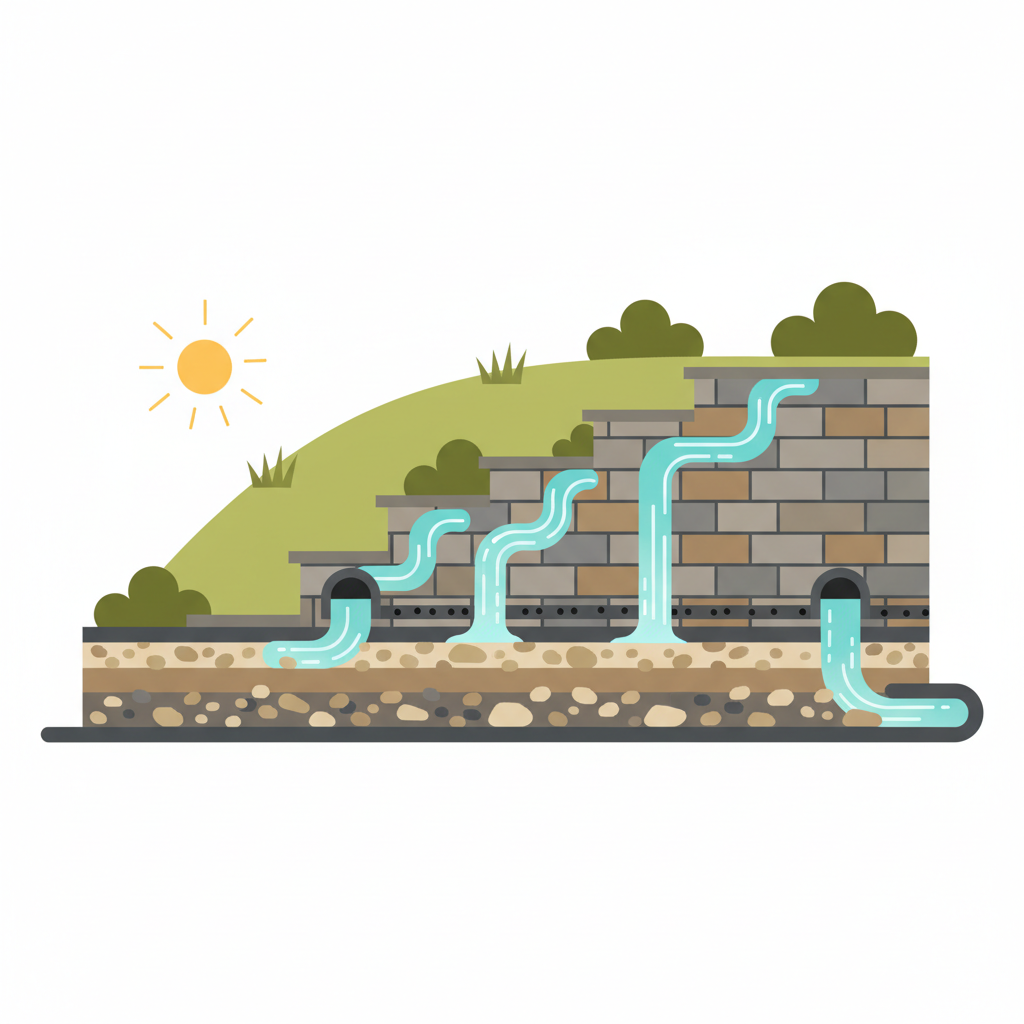
Your backyard isn’t just sloping, it’s a funneling machine that’s actively trying to push many tons of wet soil right through your expensive masonry. This hydrostatic pressure buildup is the silent killer of hardscaping. It’s a structural nightmare. But it’s also solvable. Finding the best drainage solutions for retaining walls around sloped yards depends on how you capture and move that water before it hits the wall. You need a system that breathes. You need physics on your side.
How does hydrostatic pressure threaten your retaining wall?
Gravity never sleeps. It’s pulling every drop of rain down your slope and directly against the back of your wall. When soil stays saturated, it expands and becomes heavy. This weight creates hydrostatic pressure that can crack stone and shift heavy concrete blocks. Your wall needs to be a sieve, not a dam. Most failures happen because water had nowhere to go. It builds up. It pushes. Eventually, the wall bows or collapses entirely.
Proper drainage keeps the soil behind the wall stable. It prevents the ground from becoming a liquid slurry. Stone and timber can handle vertical weight easily. They struggle with lateral pressure. You must reduce that pressure to zero.
Dry walls stay upright. Wet walls fail. It’s as simple as that. You’re building a defense system against the elements. Each layer of your wall must work together to move water away.
What are the best drainage solutions for retaining walls around sloped yards?
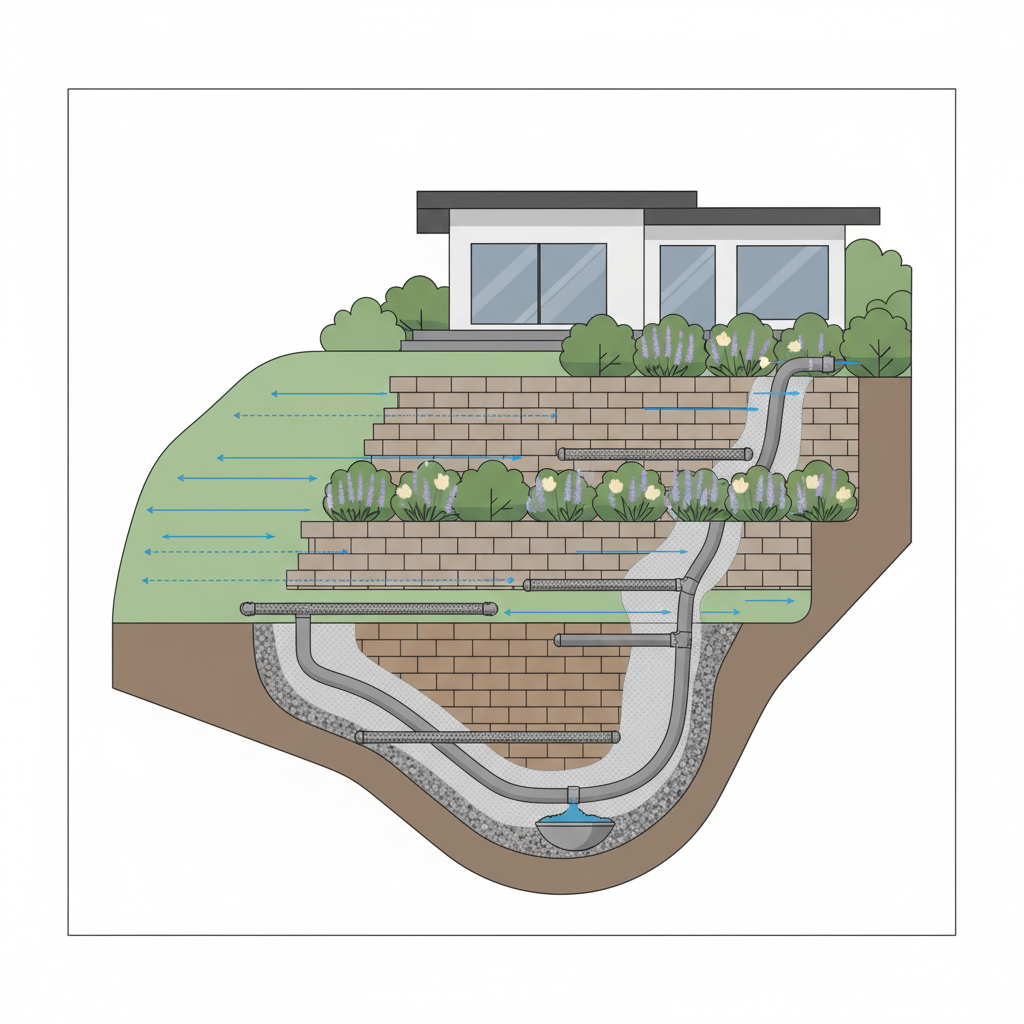
Effective management requires a multi-layered approach to soil moisture. You cannot rely on a single pipe to do all the heavy lifting. The best drainage solutions for retaining walls around sloped yards involve combining surface collection with subsurface relief. This means using French drains as your primary line of defense. These perforated pipes sit at the base of your wall’s heel. They act like a vacuum for groundwater.
You also need granular backfill. This is typically clean, 1-inch crushed stone or angular gravel. Unlike dirt, gravel doesn’t hold onto water. It allows it to drop straight down to the drain pipe. This ensures the soil directly behind the wall stays relatively dry.
Surface swales are also critical. These are shallow, grass-lined channels that catch water coming down the slope. They redirect the flow before it ever reaches the retaining structure. Think of them as a moat for your wall. They intercept runoff and send it to a safer discharge point.
Why is gravel backfill essential for sloped yard drainage?
Dirt is the enemy. Standard garden soil or clay acts like a sponge and holds moisture for days. This creates a constant heavy load against the back of your structure. When you use gravel backfill, you create a high-flow highway. Water hits the gravel and falls instantly. It can’t build up pressure.
You should use at least 12 inches of gravel directly behind the wall. More is better for steep slopes. This gravel layer should extend from the base all the way to a few inches below the surface. Top it with a thin layer of soil and sod for aesthetics.
Never use pea gravel. Pea gravel is round and rolls like ball bearings. Use angular crushed stone instead. It locks together to provide structural support while keeping the drainage pits open. It’s the backbone of a long-lasting wall.
How do weep holes prevent water buildup in masonry walls?
Water will find a way out. If you don’t give it an exit, it will make its own. Weep holes are small openings at the base of the wall that allow trapped water to escape. In stone or brick walls, these are often gaps in the mortar. In timber walls, they can be small drilled holes.
They work in tandem with the gravel backfill. As water drops through the gravel, it hits the bottom and flows out through these holes. This prevents the pudding effect at the base of your wall. Without them, water pools at the foundation.
This pooled water can undermine the footing. In cold climates, trapped water freezes and expands. This heave can lift the entire wall off its base. Weep holes are your pressure relief valves. Don’t skip them.
Can French drains handle heavy runoff on steep slopes?
Steep slopes move water fast. A standard French drain is a perforated pipe wrapped in filter fabric. On a slope, you need a high-capacity system. Use a 4-inch or 6-inch perforated NDS pipe. Ensure it is sloped at a minimum 1% grade toward the discharge area.
The filter fabric is non-negotiable. It prevents silt and fine soil from entering the pipe. If the pipe clogs, the entire system is useless. You would have to dig up the whole wall to fix it.
Position the pipe at the very bottom of the gravel trench. It should be slightly above the footing level. This ensures it catches every drop before it can seep under the wall. Direct the exit pipe to a dry well or a street-side storm drain.
Should you use swales or trench drains for surface water?
Surface water is a different beast. Trench drains, or channel drains, are grated systems that sit flush with the ground. They are perfect for the bottom of a steep hill right before the wall starts. They catch the massive volume of water that rushes over the grass during a storm.
Swales are a more natural-looking alternative. They are basically wide, shallow ditches. When properly graded, they look like a gentle dip in the landscape. You can plant them with water-loving grasses or line them with river rock.
Both methods reduce the amount of water the retaining wall has to process. It’s always easier to move water on the surface than underground. Combining a surface swale with a subsurface French drain is the gold standard. This is how you protect a high-value landscape.
What role does filter fabric play in retaining wall longevity?
Soil migration ruins systems. Over time, water carries tiny particles of dirt into your gravel. This creates a thick, muddy mess that blocks water flow. Geotextile filter fabric acts as a barrier between the native soil and your drainage gravel.
You should wrap the entire gravel column. It’s like a burrito of stone. The fabric allows water through but keeps the dirt out. This keeps your gravel clean and free-flowing for decades.
Cheap landscape fabric won’t work. Use non-woven geotextile fabric designed for drainage. It’s tougher and won’t tear during the backfilling process. It’s a small investment that doubles the life of your wall.
How do you manage downspout runoff near a retaining wall?
Roof water is a hidden threat. A single heavy rain sends hundreds of gallons of water off your roof. If your downspouts dump this water near the top of a sloped yard, your retaining wall is in trouble. It’s like a fire hose pointed at your foundation.
Never let downspouts drain onto the slope above a wall. You must pipe that water directly away. Use solid PVC pipes for this, not perforated ones. You want to move that water to the bottom of the hill without it ever touching the soil behind the wall.
Connect all downspouts to a dedicated drainage line. Bury it at least 12 inches deep. Discharge it far away from any structures or walls. This simple step removes about 50% of the water stress from your landscape.
What are the best materials for walls in high-moisture areas?
Material choice matters. Wood and timber look great but they eventually rot. Even pressure-treated wood struggles if it’s constantly wet. If you have a very wet slope, steer toward pre-cast concrete blocks or poured concrete.
Poured concrete is incredibly strong. It is less likely to allow water to seep through the face. However, it still requires heavy drainage behind it to prevent tipping. Pre-cast blocks with interlocking lips are excellent for sloped yards. They are designed to lean back into the hill slightly.
Natural stone is beautiful but porous. If you use it, you must be even more diligent with your gravel backfill. Each material has its pros and cons. But all of them will fail without a plan to move the water.
How do you design a discharge point for your drainage system?
Captured water has to go somewhere. If you just end your pipe at the edge of the wall, you’re creating a new problem. The discharge point should be a low area of the property where water won’t cause erosion.
Using a pop-up emitter is a smart choice. It stays flush with the grass until the pipe fills. Then, the lid pops up and lets the water flow out over the lawn. This prevents rodents from nesting in your pipes during the summer.
On very steep slopes, use a rip-rap apron. This is a small area of heavy rocks at the pipe exit. It breaks the speed of the water. This prevents the water from carving an ugly hole in your yard.
Protect your landscape with professional drainage design
Building a wall without a plan for water is just a slow-motion disaster. You need to think about the path of every drop. Start by identifying the best drainage solutions for retaining walls around sloped yards that fit your specific soil type. If you have heavy clay, you need more gravel. If you have a steep hill, you need bigger pipes.
Don’t cut corners on the things you can’t see. The fabric, the pipe, and the stone are the parts that actually do the work. The pretty blocks on the front are just the face of the operation. Spend your money on the guts of the system.
If you aren’t sure about your grading, call a pro. A slight mistake in the slope of a pipe can lead to a massive failure. Do it right the first time. Your yard will be dry, and your wall will stay standing for years to come.
Frequently Asked Questions About Retaining Wall Drainage
Can I use a retaining wall without a drain pipe?
Only if the wall is very short. Anything over two feet tall should have a pipe. Even short walls live longer with proper drainage. Without a pipe, you’re relying entirely on the soil’s ability to absorb water. That’s a big risk during a heavy storm.
What is the best type of pipe for wall drainage?
Schedule 40 PVC with perforations is the top choice. It’s strong and doesn’t crush easily under the weight of the gravel and soil. Corrugated black pipe is cheaper but it can clog more easily. Corrugated pipe also tends to hold onto silt because of its internal ridges.
How much gravel do I really need behind the wall?
Aim for a minimum of 12 inches. If your slope is particularly steep or the soil is heavy clay, increase that to 18 or 24 inches. This gravel column should run from the footing all the way up to just below the surface. Volume matters when it comes to managing high-speed runoff.
Do I need to clean out my retaining wall pipes?
If you used filter fabric, you shouldn’t have much maintenance. However, it’s a good idea to check the exit points once a year. Make sure no grass or debris is blocking the flow. If the water stops coming out during rain, you might have a clog that needs flushing.