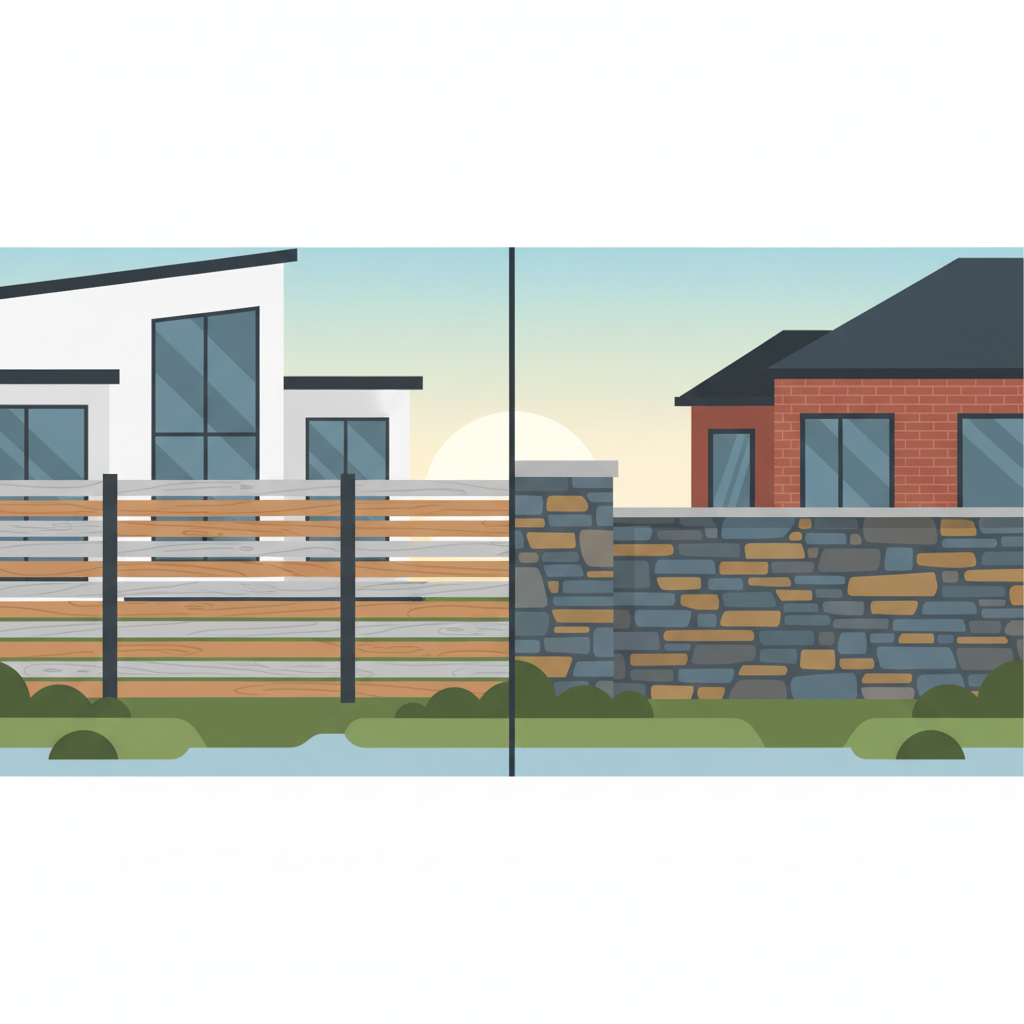
Stone walls always increase property value. You’ve heard this from every real estate agent and contractor for decades. It’s not necessarily true in the current housing market where speed and design flexibility often dictate a project’s success. Choosing between a modern privacy fence vs stone wall for new construction homes requires you to look beyond simple durability. You need to consider how your choice impacts your timeline, your budget, and the specific architectural style of your new build. It’s a decision that defines your home’s perimeter for generations.
The choice is heavy. It impacts your curb appeal instantly and forever. When you’re standing on a fresh plot of dirt, the boundary you choose sets the tone for everything inside. You want security. But you also want a look that doesn’t feel dated by the time you move in. Today’s homeowners are leaning toward sleeker lines and faster installs. But the timeless weight of masonry still calls to those looking for a permanent legacy. Let’s look at how these two heavyweights stack up in 2026.
Which option offers the best return on investment for new builds?
Money matters most. You’re already deep into construction costs, and every line item on your budget is under a microscope. A modern privacy fence vs stone wall for new construction homes presents a massive gap in initial capital requirements. Stone is labor intensive. It requires skilled masons who charge a premium for their time and expertise. You’re paying for raw materials, footings, and weeks of meticulous stacking. It’s a slow burn for your wallet. But it holds value well.
Fencing is different. It’s fast. Modern materials like composite, horizontal cedar, or powder-coated aluminum offer a high-end look at a fraction of the cost of masonry. You can fence an entire acre in the time it takes to lay the foundation for a single stone pillar. And this speed translates directly into lower labor costs. But you don’t get the same centuries-long lifespan. You trade permanence for immediate style and cash flow. Don’t ignore the maintenance math either.
Stone walls are essentially set and forget. They don’t rot. Termites won’t eat them. They don’t need staining every three years. A high-quality fence will eventually need some love. Even the best composites can fade or require a power wash. If you plan to sell in five years, the fence wins on ROI. If you’re building a family estate for fifty years, the stone wall starts to look like the smarter financial play. It’s all about your personal timeline in this house.
How does a modern privacy fence compare in terms of installation speed?
Time is fleeting. When you’re building a new home, delays are your biggest enemy. A modern privacy fence vs stone wall for new construction homes comparison isn’t even close when it comes to the clock. Most modern fence systems are modular. They arrive on-site ready to be dropped into post holes. You can have a completed, private backyard in forty-eight hours. This allows other trades like landscapers and pool builders to start their work sooner. It streamlines the whole project.
Walls are slow. They’re heavy. You have to wait for the ground to settle or pour massive concrete footings to prevent shifting. If it rains, the masonry work stops. If the stones don’t match the first batch, you’re stuck waiting for a new shipment. A stone project can easily stretch into weeks or months. This can block access for heavy machinery needed elsewhere on your lot. It’s a logistical hurdle that many new homeowners aren’t prepared to clear. Speed has a value of its own.
And you must think about the mess. Mixing mortar and cutting stone creates significant site debris. It’s a dusty, loud process that can irritate your new neighbors before you’ve even moved in. Fencing is a much cleaner installation. There’s less waste. There’s less noise. If you’re under pressure from a homeowner’s association to finish your exterior work, the fence is your safest bet. It gets the job done without the drama of a long-term construction zone. You get your privacy now, not next season.
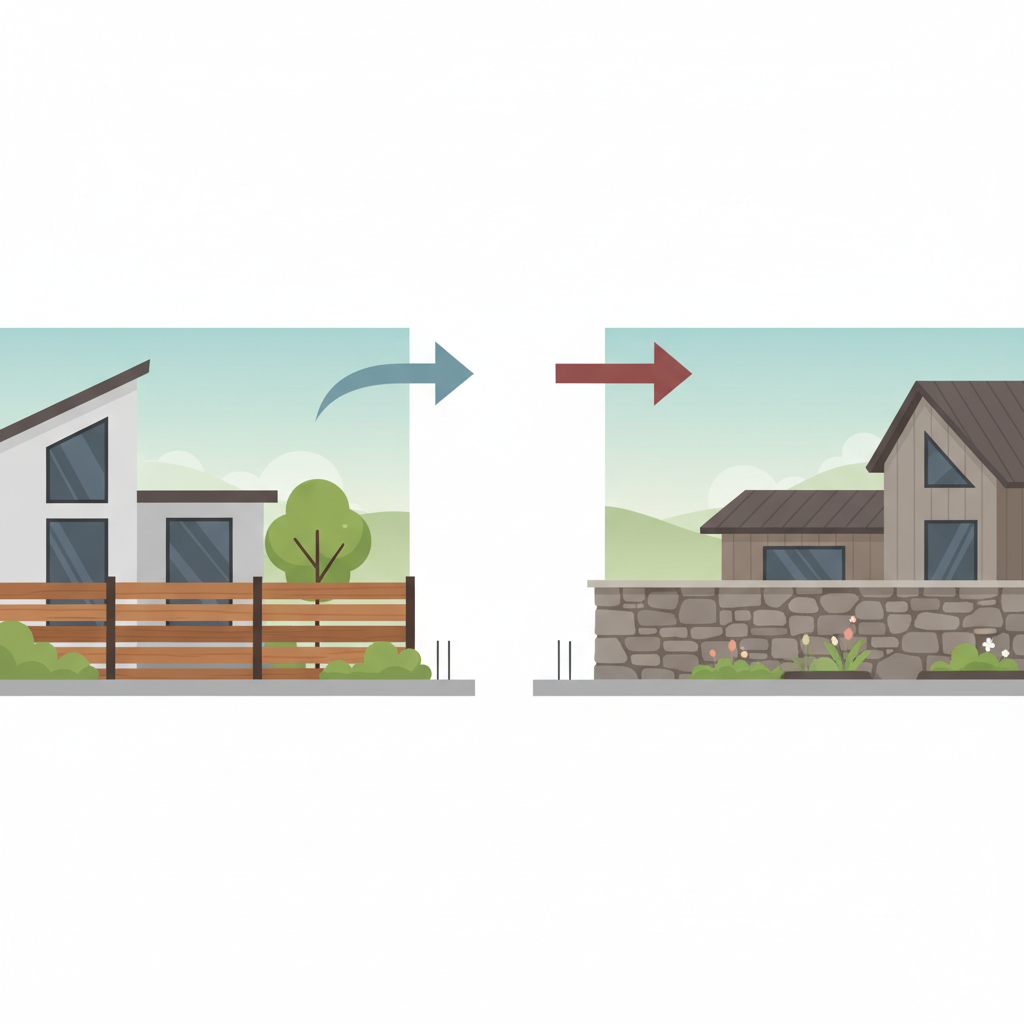
What are the aesthetic differences for contemporary home designs?
Design dictates mood. A modern privacy fence vs stone wall for new construction homes will completely change the vibe of your exterior space. Modern fences often feature horizontal slats that make a yard feel wider. They use mixed materials like metal and wood. This creates a textured, layered look that matches 2026 architectural trends. It feels light. It feels intentional. It’s the perfect backdrop for a minimalist garden or a sleek outdoor kitchen.
Stone is heavier. It’s grounded. A stone wall gives a sense of history and permanence that wood or metal can’t replicate. It works beautifully with organic modern designs or traditional estates. But stone can also feel cold. It’s a hard surface that reflects sound rather than absorbing it. If you have a small lot, a thick stone wall can make the space feel cramped or fortress-like. You have to balance that literal weight with soft landscaping. It takes more work to get right.
Think about height too. Most municipalities have strict rules about how high a solid wall can be. Fencing often gets more leeway. You can use lattice tops or semi-transparent slats to gain height without breaking code. This lets you block a neighbor’s second-story window while still letting light through. A stone wall is an all-or-nothing barrier. It doesn’t breathe. It’s a solid block of privacy that can sometimes feel like a prison wall if not designed with care. Choose the material that fits your vision.
Which boundary type offers better long-term durability and maintenance?
Stone is king. There’s no getting around the fact that a well-built stone wall will outlast any fence. We see stone structures from hundreds of years ago still standing today. It withstands extreme weather, from blistering heat to deep freezes. It doesn’t warp. It doesn’t lean. If you want a boundary that your grandchildren will see, stone is the only real choice. It’s the definition of a permanent structure. It’s built for the long haul.
Fences have improved. Modern composites are incredible. They use recycled plastics and wood fibers to create something that won’t rot or attract bugs. High-grade aluminum fences have coatings that resist salt and UV damage for decades. But they still have moving parts. Gates will eventually sag. Screws can loosen over time. Even the best modern privacy fence vs stone wall for new construction homes comparison shows that the fence is the more fragile option. It will need a check-up eventually.
But maintenance isn’t just about survival. It’s about look. A stone wall can grow moss or accumulate lime staining over time. Cleaning it requires specialized chemicals or light pressure washing. A fence might just need a quick wipe-down. If a tree limb falls on a fence, you replace a panel. If a tree limb hits a stone wall, you’re calling a mason for an expensive repair. You have to decide which type of work you’re willing to do. Both require an eye on the future.
How do local zoning laws impact your choice of material?
Rules rule. Before you buy a single bag of cement or a wooden post, you must check your local codes. Many new construction developments have restrictive covenants. They might ban stone walls entirely because of drainage concerns. Or they might mandate a specific type of modern privacy fence to keep the neighborhood looking uniform. You don’t want to build a masterpiece only to be forced to tear it down. It happens more often than you think.
Walls are heavy. They’re structures. In many jurisdictions, a wall over three or four feet requires an engineered drawing and a separate building permit. This adds cost and time to your project. Fences are usually treated as temporary or light structures. Permits are often easier to get. They’re faster to approve. If your property has a steep slope, a stone wall becomes a retaining wall. That’s a whole different level of engineering and expense. It complicates everything quickly.
And then there’s the property line. Fences are thin. You can put them right on the edge of your lot. Stone walls are thick. They might be twelve to eighteen inches wide. If you build it on the line, you might be giving up six inches of your yard to the other side. Or you might have to set it back, creating a weird no man’s land between your wall and the neighbor. It’s a spatial puzzle. Measure twice before you commit to the weight of stone.
Can you combine stone and modern fencing for a custom look?
Hybrid is best. You don’t have to choose just one when looking at a modern privacy fence vs stone wall for new construction homes. Some of the best-looking properties in 2026 use both. You can build a low stone base or knee wall and top it with modern horizontal fencing. This gives you the visual weight and durability of stone at the ground level where moisture is high. But it keeps the upper half light and airy. It’s the best of both worlds.
Stone pillars are another great option. You can space them out every eight or ten feet. Between the pillars, you install high-quality fence panels. This creates a rhythmic, high-end look that feels more expensive than it is. It anchors the fence to the ground. It makes the whole perimeter look like it was designed by an architect. It’s a strategic move for curb appeal. It creates a sense of luxury without the total cost of a solid stone barrier.
And let’s talk about landscaping. You can use stone for the front of the house to impress guests and neighbors. Then switch to a modern privacy fence for the backyard where you just need a place for the kids to play. Nobody says the whole lot has to be identical. Use the stone where it adds the most value. Use the fence where it adds the most function. It’s a smart way to manage your budget while still getting a premium look. Mix and match with confidence.
What are the environmental impacts of each material?
Green is the goal. Your choice of modern privacy fence vs stone wall for new construction homes has a carbon footprint. Stone is natural, but quarrying and transporting it is energy-intensive. It’s heavy to move. It takes a lot of fuel to get it to your site. However, it’s a one-time cost. Once it’s there, it stays for centuries. It doesn’t release chemicals into the soil. It’s as inert as it gets. It’s the ultimate sustainable choice if you think in terms of centuries.
Fences are getting greener. Recycled composites keep plastic out of landfills. Many wood fences now come from FSC-certified forests. But manufacturing these products involves factory processes. They have a shorter lifespan. When a fence reachers the end of its life, it might end up in a landfill. Some metals are highly recyclable, which is a plus. But you have to look at the whole lifecycle. A fence you replace three times in fifty years has a different impact than one stone wall.
Think about your local ecology. A solid stone wall can block the movement of small animals like turtles or hedgehogs. It’s a hard barrier for nature. A fence, especially one with a small gap at the bottom or between slats, is more permeable. It lets the wind through. It lets small critters through. It doesn’t change the micro-climate of your yard as much as a heat-absorbing stone wall might. Sustainability is about more than just the material. It’s about how the structure lives with the land.
Choose the boundary that fits your 2026 lifestyle
Your home is your sanctuary. The decision between a modern privacy fence vs stone wall for new construction homes shouldn’t feel like a chore. It’s an opportunity to define your space. Start by looking at your immediate needs. Do you need privacy by next week? Go with a modern privacy fence. Are you building your forever home and want a legacy? Build the stone wall. Don’t let trends dictate a choice that you’ll have to live with for years. Trust your gut and your budget.
Check your site conditions. If you have sandy soil or a lot of shifting, a heavy wall might be a mistake. If you live in a high-wind area, a sail-like fence could be a liability. Talk to a local contractor who knows the area’s geology. They can tell you what works and what fails. And don’t forget to look at your house. Your boundary should feel like an extension of your architecture. It should lead the eye toward your front door, not distract from it. Make it count.
You have the power to create a peaceful, private environment. Whether you choose the sharp, clean lines of a horizontal slat fence or the rugged, timeless texture of natural fieldstone, make sure it serves you. A home is more than just four walls. It’s the whole lot. Your perimeter is the first thing you see when you arrive and the last thing you see when you leave. Choose something that makes you proud to be home. Take the leap and secure your view.
Ready to start? Get three quotes from different specialists to see the real-world cost in your zip code. Compare those numbers against your move-in date and your long-term goals. Your dream home deserves a boundary that’s just as beautiful as the interior. Get out there and build it.
Frequently Asked Questions
-
Which is more expensive, a modern fence or a stone wall?
In almost every case, a stone wall is significantly more expensive. This is due to the high cost of raw materials and the specialized labor required for masonry. A modern fence can offer a similar level of privacy for 30% to 50% of the price of a wall. -
How long does a stone wall typically last?
A well-constructed stone wall with proper footings can last over 100 years. Unlike wood or even some composites, stone does not rot or suffer from insect damage. It is the most durable boundary option available for residential properties. -
Do I need a permit for a modern privacy fence?
Yes, most cities require a permit for any fence over a certain height, usually six feet. Stone walls often have even stricter requirements. They may require an engineering plan if they are over three feet tall or acting as a retaining wall. Always check with your local building department first. -
Can a modern fence increase my home’s value as much as stone?
A high-quality modern privacy fence can significantly boost curb appeal and attract buyers who want immediate privacy. While stone is often seen as more prestigious, a stylish, well-maintained fence is a major selling point in contemporary real estate markets.